
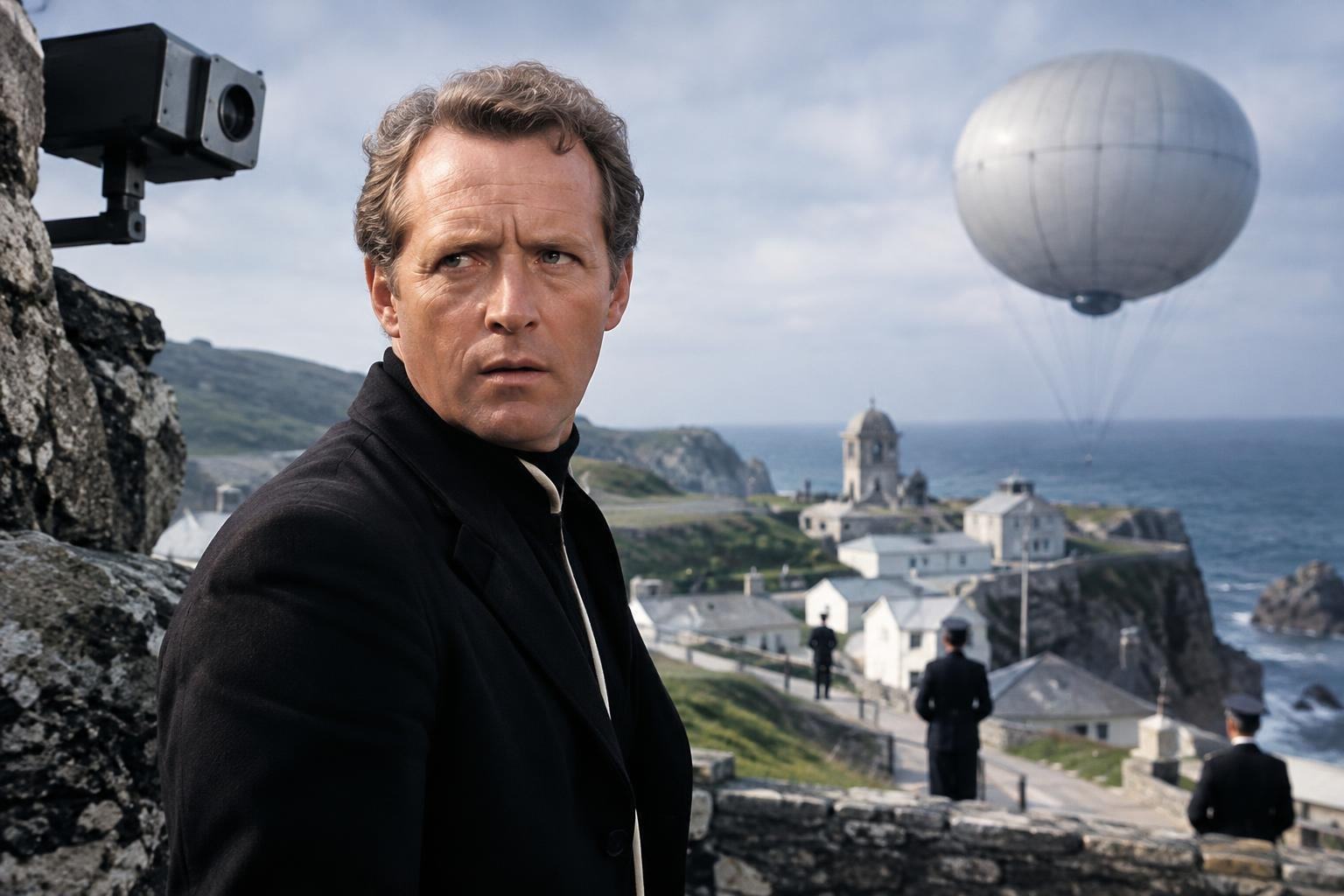
A man resigns from a secretive job, returns home and is rendered unconscious by gas pumped through his keyhole. When he wakes, he is in a seaside settlement called the Village, where he has been assigned a number: Six. His captors want to know why he quit. His answer, repeated across the series, is a declaration of independence: “I am not a number! I am a free man!”
That opening, staged like a miniature experimental film, sets the terms of The Prisoner. Patrick McGoohan’s 17-episode series, now streaming in a remastered edition on the Criterion Channel, is a spy thriller that keeps slipping its genre’s leash. Its central question is not how Six will defeat his latest opponent, but whether any person can stay fully themselves when an institution insists on watching, sorting and interpreting them.
A spy show that refuses to play by spy-show rules
McGoohan had already played secret agent John Drake in Danger Man, known in the United States as Secret Agent. That series sent Drake on missions under a jaunty theme song. The Prisoner begins with a resignation instead. The new protagonist is never given a name, and the idea that he is Drake in another chapter remains a fan theory, not a confirmed part of the show’s story.
Each week, a different Number Two represents the Village’s authority, while Six looks for a way out or tries to frustrate its latest scheme. Even escape has an absurd obstacle: Rover, a huge, roaming balloon that can hunt down anyone who gets too close to freedom. The repetition is the point. The Village changes its tactics, but the contest keeps restarting, turning the familiar adventure of a clever hero outwitting his enemies into something more bleakly circular.
That doesn’t make the series a grim endurance test. McGoohan plays Six with sharpness, pride and a streak of mischief; his resistance can be funny even when it seems doomed. The show’s oddness is not a decorative layer over a conventional thriller. It is what makes the struggle feel unstable: the rules can change, authority figures can be replaced, and explanations are often less satisfying than the questions they leave behind.
The Village’s surveillance has left the screen
The Village’s cameras, informants and listening devices once worked as heightened symbols of institutional power. From a 2020s perspective, they also recall a world where location data, connected devices and digital records can make personal information available to companies and authorities. The comparison is not that a fictional seaside prison predicted every modern technology. It is that the show understood the discomfort of living under observation—and of not knowing who is watching, or what they can infer.
Information is the Village’s currency. Six’s captors want more than a confession: they want to turn his habits and motives into something they can use. In “It’s Your Funeral,” a computer tries to predict what he will do by analysing his past behaviour alongside information about other villagers. The episode’s premise feels newly resonant amid contemporary debates about predictive systems, but it is best read as a sharp piece of speculation, not a technical forecast of today’s artificial intelligence.
That tension between the individual and the collective also offers a useful way into the show for viewers who know later mysteries such as Lost or Twin Peaks. The Prisoner helped establish that television could build its power through atmosphere, strange repetitions and withheld answers. Its influence is part of its reputation; watching it now reveals that the original is not merely a historical footnote to newer, more celebrated puzzles.
Freedom is more than finding the exit
One of the series’ most memorable episodes, “Many Happy Returns,” lets Six reach London, only for his homecoming to deepen the trap. The world appears to have carried on without him, and even the possibility of finding the Village again turns against him. The episode’s bleakness is tempered by the show’s sly humour, but its central unease remains: escape may not restore the life that was taken.
That is why The Prisoner still works as more than a clever template for later TV. Its most lasting fear is not simply that someone might assign us a number. It is that we might begin to accept the number as a complete account of who we are. The Village’s famous farewell, “Be seeing you,” sounds like a catchphrase; today, it can also feel like a promise that the watching will continue.