
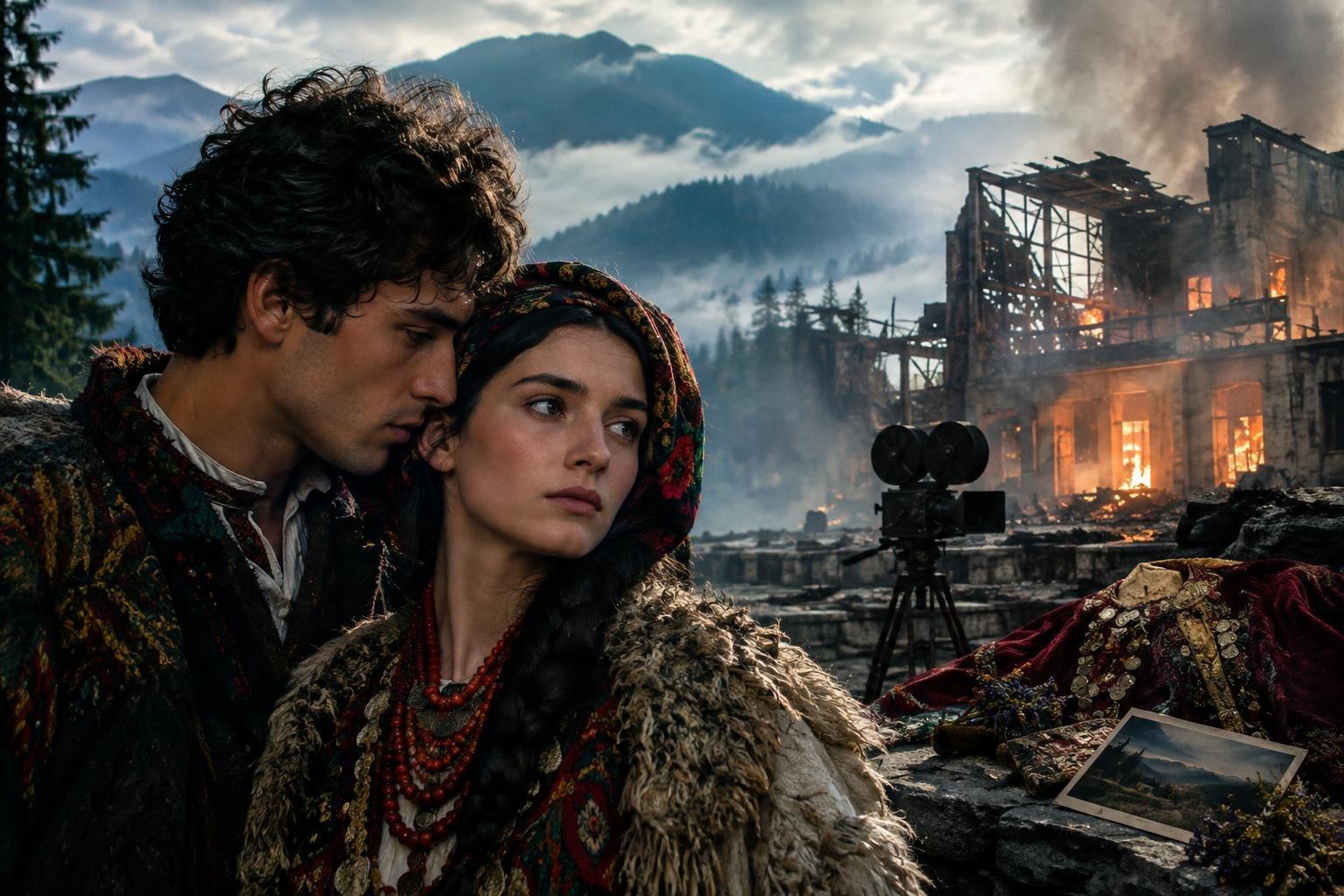
A film studio is more than the place where a movie gets made. It is also a storehouse of a country’s screen history: costumes, craft and creative memory built up over generations. When a Russian missile strike damaged Kyiv’s Dovzhenko Film Studio on a summer night in 2026 and its vast costume collection went up in flames, the damage reached beyond one production site.
The studio is where Sergei Parajanov made Shadows of Forgotten Ancestors, his 1965 break from the constraints of Soviet socialist realism. The film’s story is rooted in Ukrainian folklore and language, but its importance reaches further: it shows how cinema can preserve cultural identity not through a speech, but through the texture of a world.
A love story told in the language of landscape
Set among the Hutsuls of Ukraine’s Carpathian Mountains, the film follows Ivanko and Marichka, whose love is shaped by family violence, loss and the forces of nature. Their community’s beliefs bring together pagan tradition and Orthodoxy. Here, the forest is not just a backdrop: it feels alive, charged with the presence of spirits, memory and danger.
Parajanov and co-writer Ivan Chendej adapted the film from Mykhailo Kotsiubynskyi’s 1911 novella. The writer had rendered the natural world in startling, shifting images; Parajanov found a cinematic equivalent in saturated colour, unusual angles and vivid objects. A tree’s fall can unsettle the viewer’s sense of perspective; blood across the camera lens gives way to the startling image of red horses.
The film asks us to see the world as more than a human stage. Animals, weather and landscape carry emotional weight, while rituals and handmade things seem to hold their own power. That sensibility distinguishes it from a conventional historical romance—and helps explain why its images remain so striking.
One film, several cultural homelands
Parajanov was born in Tbilisi to Armenian parents and later made Ukraine one of his artistic homes. He described having three motherlands, all then within the Soviet Union. His work resisted the idea that culture should flow from one central authority: Shadows gave Ukrainian language and folk life a vivid place on screen, while his later films turned toward Armenian, Georgian and Azerbaijani traditions.
That creative independence had a cost. Parajanov had spent years making films within Soviet production before Shadows opened a new path. Its nonconformism drew disapproval from the regime, and he was later imprisoned under laws criminalizing homosexuality. His incarceration was officially recognized in Ukraine as politically motivated in 2024.
Even away from filmmaking, he continued to make art from whatever materials he could find. That persistence offers a powerful counterpoint to the destruction of a studio collection: objects can be vulnerable, but the creative impulse they represent is harder to extinguish. It is a distinction, not a consolation. A burned costume cannot simply be replaced by the memory of what it meant.
Why the film feels newly urgent
The strike does not change what Shadows of Forgotten Ancestors is, nor does it make the film a documentary record of the attack. But it sharpens the questions already inside it: whose traditions survive, who gets to tell their stories, and what happens when a culture is treated as something to be absorbed or erased?
For viewers coming to Parajanov for the first time, the film rewards attention to its images as much as its plot. Look at how colour, movement and objects shape the story’s emotional world; notice how the landscape seems to participate in the characters’ fate. This is a work that makes folklore feel less like a distant inheritance than a living way of seeing.
The Dovzhenko studio’s damaged collection stands as a reminder that film heritage is material as well as imaginative. Shadows of Forgotten Ancestors endures because Parajanov made a culture visible without reducing it to an emblem. Its images ask what can be carried forward when the places and objects that held memory are under threat.