
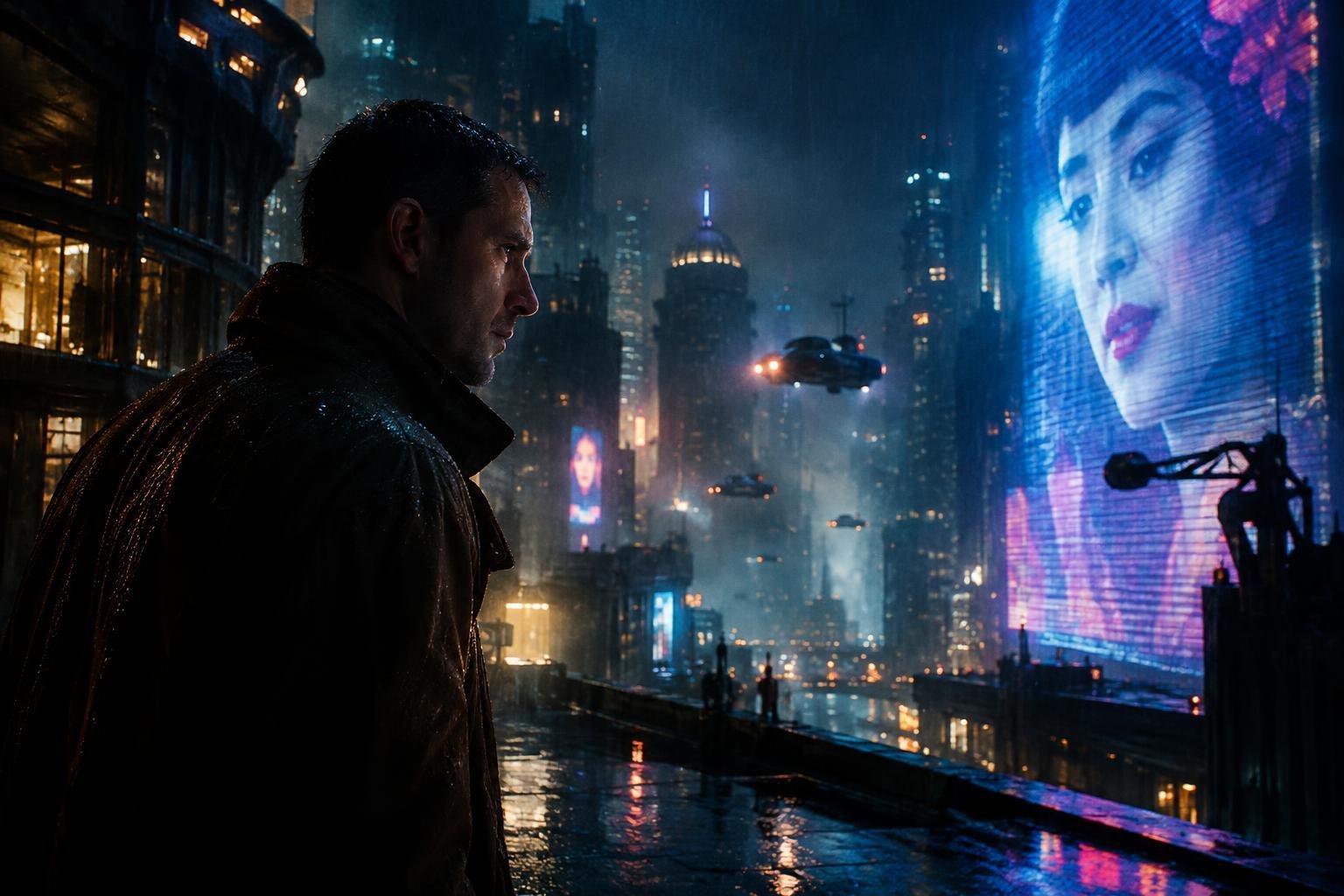
Los Angeles in Blade Runner was meant to be the future. In 2015, the year of the film’s return to cinemas, its imagined 2019 is close enough to feel less like science fiction’s distant horizon and more like a warning from just around the corner. Yet the film’s most unsettling question is not whether technology will change our cities. It is whether we will recognise a person when we meet one.
Ridley Scott’s film follows Rick Deckard, a weary detective tasked with hunting down replicants: artificial beings so like humans that the distinction becomes difficult to defend. The assignment sounds straightforward. The film makes it morally treacherous. That tension, wrapped in a story of pursuit and survival, is one reason this future-noir has grown richer with time.
A future built from the past
Scott’s Los Angeles is a city of darkness, rain and industrial sprawl, but its visual language is not simply futuristic. The production brought together Scott, visual futurist Syd Mead, production designer Lawrence G. Paull, art director David L. Snyder and effects artists Douglas Trumbull and Richard Yuricich. Miniatures and painted backdrops helped give the metropolis its dense, physical scale.
The result looks less like a clean prediction than a crowded memory of possible futures. Film noir supplies the shadows and fatalism; older Hollywood gives Deckard the outline of a hard-bitten detective. The film’s visual references reach back to Edward Hopper’s Nighthawks and the cluttered rooms of classic cinema. Vangelis’s electronic score likewise mixes futuristic textures with lonely saxophone and bluesy melancholy.
That blend matters. Blade Runner’s future feels old because it is built out of the past—a world carrying the debris of earlier dreams and failures. Its beauty is inseparable from its decay, and its technology never quite banishes the human need for connection.
The argument behind the mystery
The film’s central uncertainty extends beyond its hunted replicants to Deckard himself. A dream involving a unicorn became a key clue for viewers who read him as an android with implanted memories. Scott has supported that interpretation; Harrison Ford has disagreed, arguing that the audience needs a human figure with whom to connect.
The disagreement is more than a puzzle for fans to solve. If Deckard is human, the film asks how easily people can treat others as disposable. If he is a replicant, the question turns inward: what makes his feelings or memories less real? The ambiguity shifts the story from identifying the machine to examining the human observer. The film offers evidence but leaves room for viewers to decide how much certainty they need.
A film remade by its own history
The film’s complicated production became part of its mythology. Scott’s demanding night shoots brought friction with the cast and crew, and his working relationship with Ford was difficult. After test screenings, producers replaced the original ending with a more reassuring one and added explanatory narration. The release disappointed at the box office, failing to recover its reported $28 million budget.
Its reputation changed as home video gave audiences another chance to revisit it. Scott later restored versions closer to his intentions, including the 1991 Director’s Cut and the 2007 Final Cut. Across seven edits, the film’s history became a debate about authorship as well as a debate about Deckard. The version returning to cinemas is the Final Cut, without the imposed narration or upbeat ending.
Philip K. Dick’s 1968 novel, Do Androids Dream of Electric Sheep?, provided the foundation, but the film reshaped its imagined world. Dick’s story centres on an ecologically damaged Earth, dwindling animal life and a society fractured by who can leave the planet. Scott’s adaptation turns its emphasis toward the city and the unsettling intimacy between hunter and hunted.
That change helps explain the film’s lasting hold. Blade Runner is not only a forecast of gadgets or architecture; it is a story about the ways societies decide whose life matters. Its neon and rain may belong to a specific cinematic vision, but its most enduring image is a person looking at another person and wondering what makes them real.