
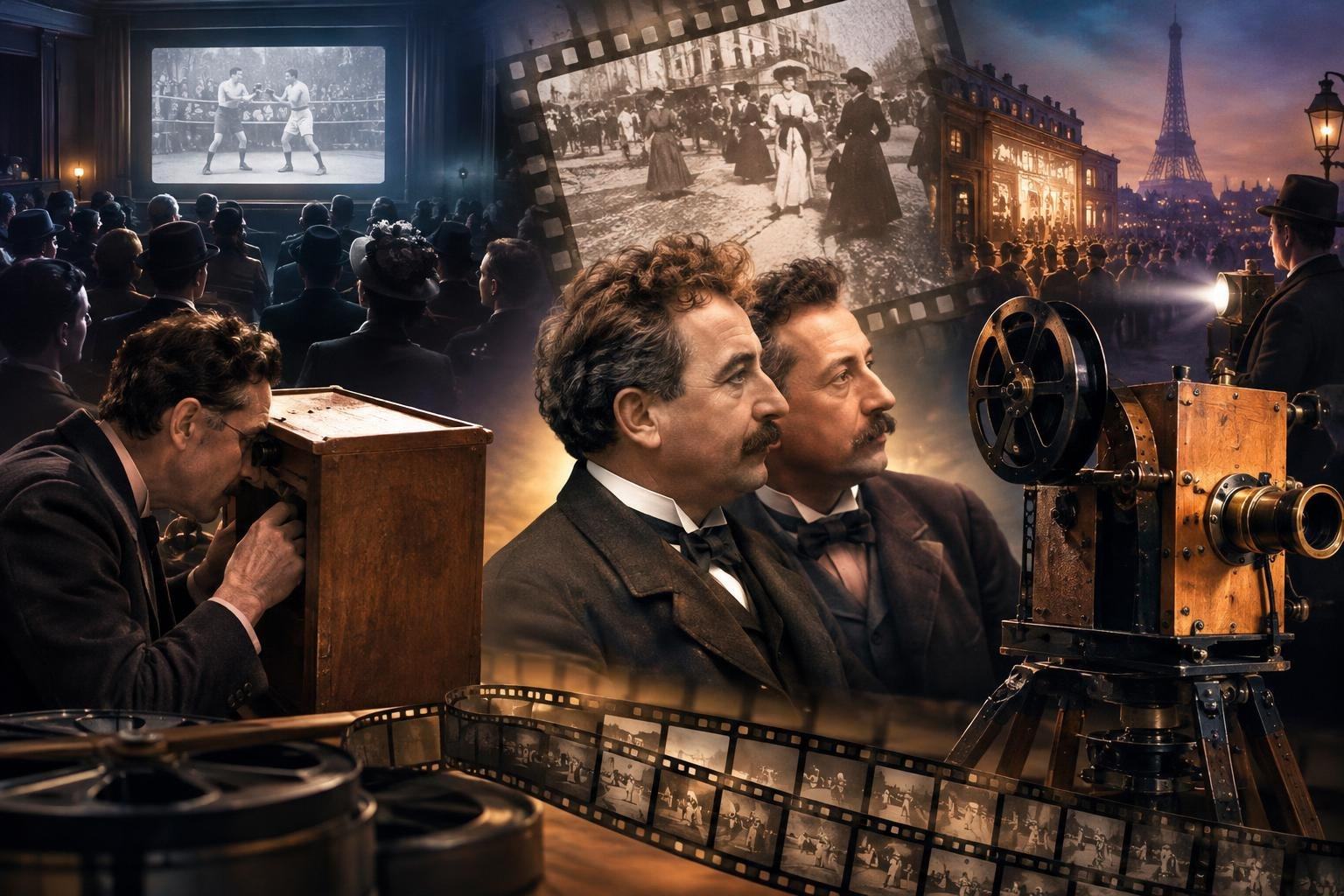
Ask who invented cinema and the Lumière brothers are likely to come up first. Their December 1895 Paris screening has become a neat starting point for film history. But the first paying audience to watch projected moving pictures did so seven months earlier, in New York—and the Lumières’ importance lies less in being first than in what they did next.
Before the screen, there was a viewing box
Early movie history did not begin with a dark room full of people facing a screen. In 1894, customers paid to bend over an Edison Kinetoscope and peer through a small opening at a short moving-image sequence. The experience was intimate, brief and, by the account of the period, hard on the neck.
The machine was the result of years of work at Edison’s operation, overseen by William Dickson. Edison had first pursued another approach, recording tiny photographs on a cylinder, but it failed. A meeting with movement researcher Étienne-Jules Marey at the 1889 Paris Exposition helped turn his attention to images captured on film.
The Kinetoscope made moving pictures a commercial attraction, but it also posed an obvious challenge: could the pictures be shown to a crowd instead? Several inventors were already working on parts of the answer. British photographer William Friese-Greene designed a motion-picture camera, though projection remained an obstacle. In Germany, the Skladanowsky brothers were projecting short films in Berlin by November 1895.
The screening that came before the Lumières
In New York, a team associated with the Lambda Company developed the Eidoloscope, a projection system that could show a longer program than the brief Kinetoscope films. On May 20, 1895, a paying audience at 156 Broadway watched a projected 12-minute boxing match. That date makes the Lumière screening in Paris, seven months later, an important landmark—but not the first paid public film show.
The Eidoloscope’s ambitions went beyond duration. It used wider film stock and a widescreen image, and its films ran at a faster rate than the Lumière system. Audiences saw more than boxing: the program expanded to include subjects such as street scenes, dances, horse races and seascapes. The system also appeared in several American cities during 1895.
Yet getting there first did not guarantee lasting influence. The Lambda group lacked the financial reach, organisation and marketing strength of its competitors. Edison’s company later introduced the Vitascope, while the Lumière Cinématographe arrived in the United States. The Eidoloscope’s early lead did not become a durable business.
What the Lumières brought to the picture
The Lumière brothers’ machine was both a camera and a projector. Compact and reliable, it helped make film exhibition practical and repeatable. Its limitations were real: it ran at about 15 frames per second and could hold only enough film for roughly 50 seconds. But the brothers produced and distributed a large body of carefully photographed films, helping establish cinema as a recognizable public attraction.
Their path to the machine is less straightforward than the familiar story of a sudden flash of inspiration. Louis Lumière later described devising a film-transport mechanism while ill in bed, imagining a sewing machine’s movement adapted for film. But the source material also points to earlier contact with inventor Georges Demenÿ, whose designs included a similar intermittent mechanism. That makes the lone-brainwave version difficult to accept as the whole story.
Other pioneers deserve a place in the account, too. British inventors Robert Paul and Birt Acres developed a camera in 1895, and their films and projectors reached audiences in a number of countries. Their work, like that of Friese-Greene and the Skladanowskys, shows that cinema emerged through overlapping experiments rather than one isolated act of invention.
There was no single starting line
It is tempting to give cinema one inventor, one machine and one birthday. The evidence instead suggests a chain of ideas: cameras that could capture movement, mechanisms that could move film reliably, and projectors that could turn private viewing into a shared event. Different teams solved different problems, and some promising technologies lost out for reasons beyond their technical merits.
The Lumières still matter enormously—not because they did everything first, but because their work helped cinema travel and take hold. Even the word “cinema,” often associated with their Cinématographe, has a more tangled history. The broader lesson is more enduring than any single origin date: screen history is shaped not only by who invents a possibility, but by who makes it visible to the world.