
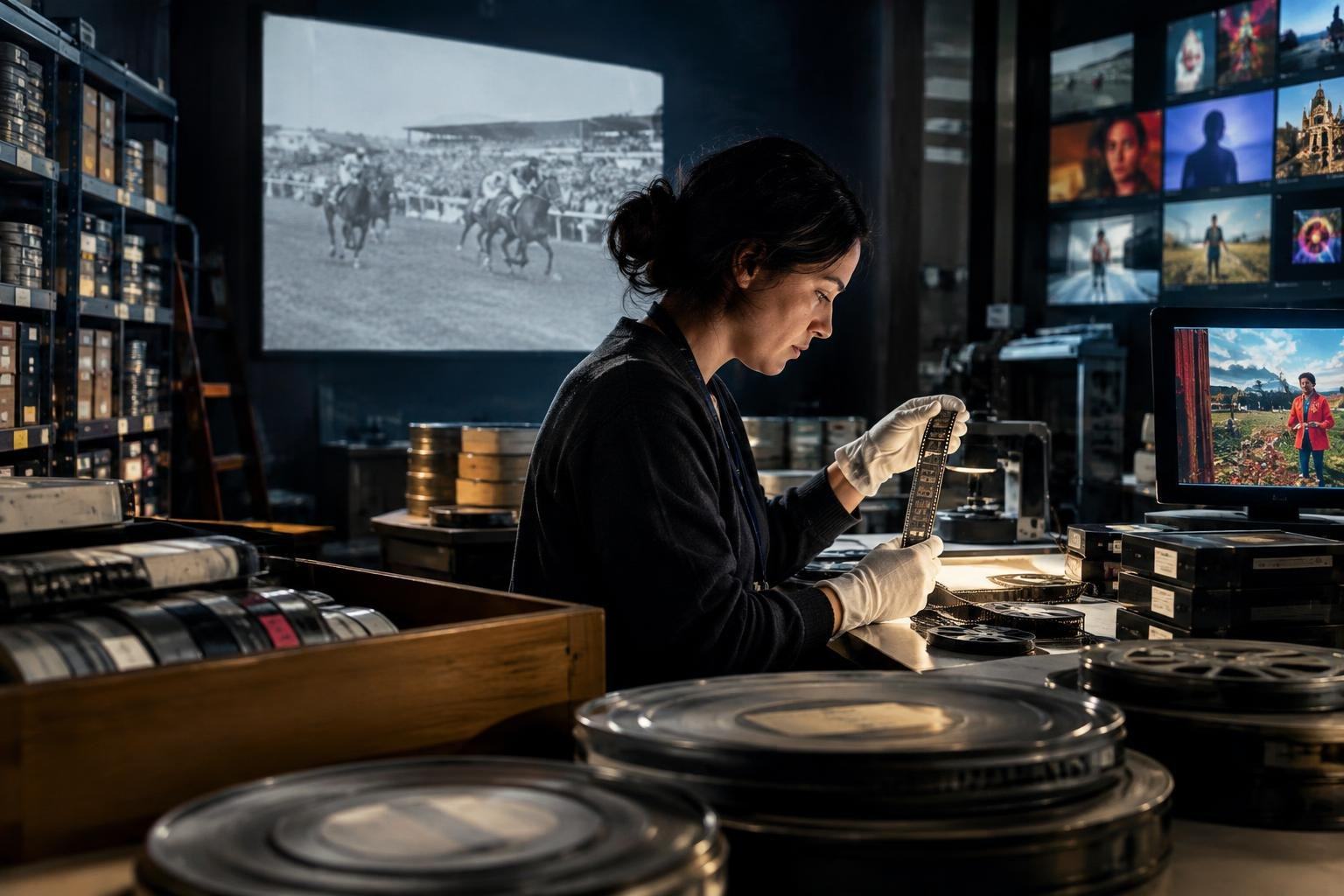
A film can vanish without ever being forgotten. It may survive only on a fragile tape, in a filmmaker’s files or as a digital work that was never made for a cinema screen. The BFI National Archive’s job is to help ensure that moving images remain available to future generations—but deciding what to preserve is more complicated than making a list of classics.
The archive holds material spanning more than a century, from Birt Acres’ The Derby (1896), among the earliest known British films, to unreleased programmes and festival-ready features. Its international holdings include one of the world’s most significant collections of silent cinema. The collection is not just a record of celebrated films: it can also show how people made, watched and shared moving images in different eras.
There is no simple “best of” list
With finite storage and substantial work involved in bringing material into the collection, the BFI has to be selective. Its stated policy focuses on film’s artistic, historical and cultural impact, with particular attention to British production and storytelling. That gives the curators a framework—but not an automatic answer to every offer.
They consider whether an item fits the policy and current priorities, whether the archive already holds the work, and whether the offered material can actually be used. If a version is already in the collection, a new copy might still be valuable if it is of better quality or could improve access. Sometimes another national or regional archive may be a more appropriate home.
No single curator makes the final call. Curators recommend acquisitions, which are discussed at a monthly Acquisitions, Disposals and Loans meeting. The group has authority delegated by the BFI’s Collections Board; proposals needing more detailed consideration or resources may go to the board itself. The process recognises that preservation is a practical decision as well as a cultural one.
How films and programmes find their way in
One route begins with the people and organisations who make, own or hold the material. Filmmakers, collectors, production and distribution companies, streaming services, industry bodies and members of the public can all make offers. The archive says donations may range from a large group of prints to a single digital file.
That matters especially in the UK, where there is no legal deposit system for moving images. The BFI says it has no acquisition budget for the national collection, so its collecting relies on donors giving physical materials or digital assets. In other words, an archive’s picture of screen culture depends partly on relationships: what people are willing to entrust to it, and what curators can identify and pursue.
A second route comes through productions supported by the BFI Filmmaking Fund, which are required to deposit materials in the archive. That helps preserve new UK work as well as older films. Dedicated curatorial archivists also assess public offers, asking for basic details—such as the title, release date and format—to understand what a donation involves.
Preserving the screen beyond cinemas
Not every important moving image began life on film or television. The BFI’s National Lottery-funded Heritage 2022 project involved digitising 100,000 works from at-risk videotapes held across the nation’s archives. Another strand of the National Lottery-funded Our Screen Heritage project focuses on acquiring and preserving a selection of 400 born-digital online works.
Those projects point to a broader challenge: screen history keeps changing shape. A videotape and an online work raise different practical questions, but both may help tell a story that would otherwise be harder to find in the future. Collecting, then, is not only about saving famous titles. It is also about noticing forms and voices that established ideas of film history might overlook.
Once an acquisition is approved, the archive completes an agreement before taking delivery. That step is part of a longer commitment to care, preservation and access, rather than a promise that every item will immediately be available to watch. The most revealing question may not be whether an archive can predict what audiences will value in a century. It is whether it can preserve enough of today’s varied screen culture for those audiences to make up their own minds.