
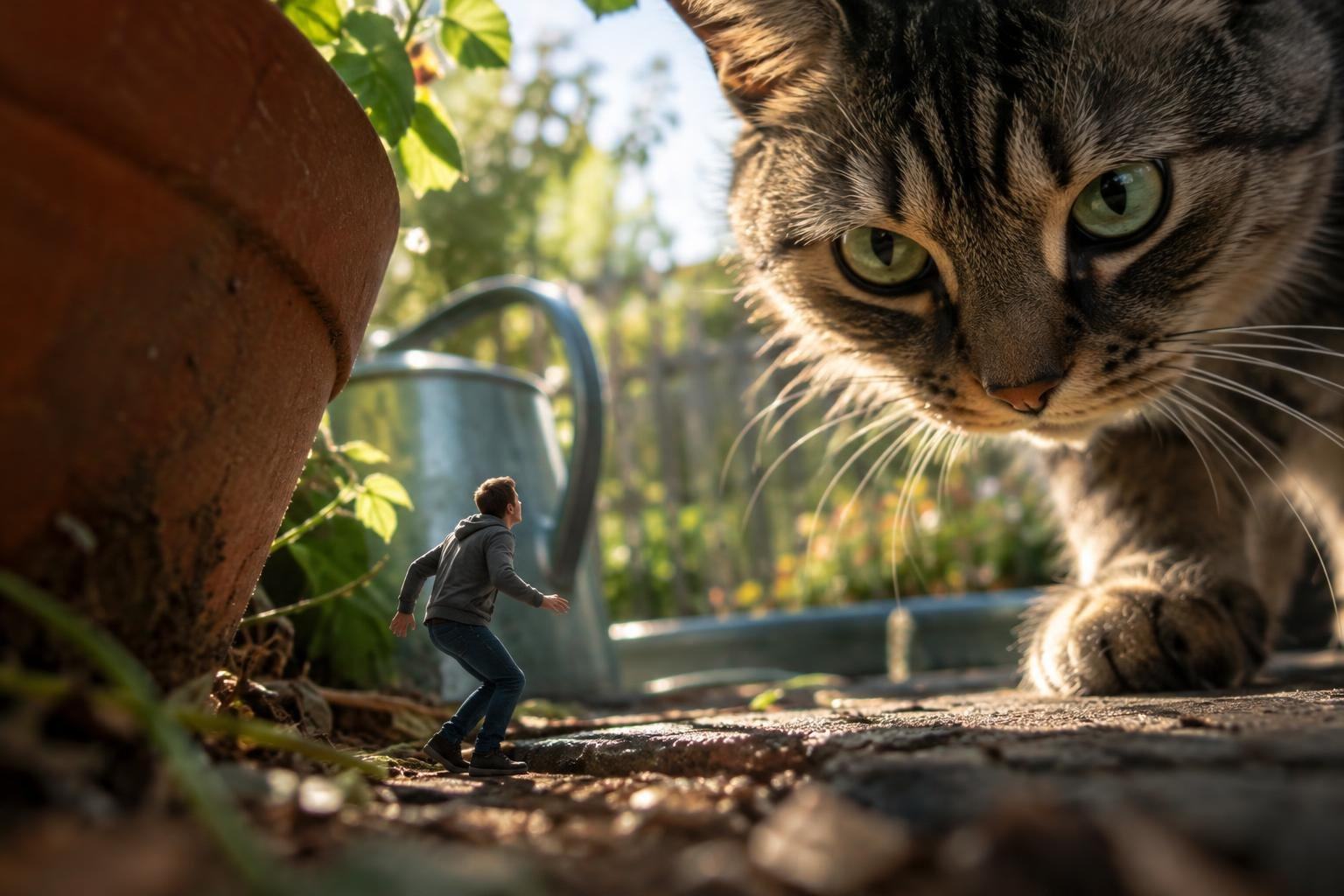
A lawnmower becomes a monster. A house cat turns into a predator. A glass of water might as well be a lake. In shrinking movies, the everyday world is not merely made larger: it becomes newly dangerous, wondrous or absurd.
That simple change of scale has kept filmmakers busy since cinema’s earliest days. The effects have evolved from camera tricks to computer animation, while the reasons for making characters tiny have shifted with the times. These eight films chart a journey from visual marvel to social satire.
When shrinking was a cinematic magic trick
Alice in Wonderland (1903), directed by Cecil M. Hepworth and Percy Stow, was the first film adaptation of Lewis Carroll’s story. Its standout transformation comes when Alice drinks from a vial and becomes small enough to pass through a door. The effect is thought to have relied on manipulating the camera lens, a resourceful solution in a young medium still discovering how to show the impossible.
More than three decades later, Tod Browning’s The Devil-Doll (1936) gave miniaturisation a darker purpose. Lionel Barrymore plays a wrongly convicted man who uses a scientist’s shrinking technology to seek revenge, controlling the tiny figures known as the Devil Dolls. Superimposed images and oversized props help sell a story that mixes crime, horror and science fiction. Its small figures are not simply spectacle: they are instruments of vengeance.
Dr. Cyclops (1940) makes the scale shift more physically threatening. Ernest B. Schoedsack’s Technicolor horror follows a group of people miniaturised by a scientist, leaving them vulnerable to his giant presence—and to his cat. Rear projection and practical effects, including a mechanical hand, helped the small and large characters share the screen. Here, the world’s new proportions turn a familiar animal into a genuine menace.
From Cold War dread to backyard adventure
In Jack Arnold’s The Incredible Shrinking Man (1957), shrinking is less a trick than a relentless predicament. A father begins to diminish after exposure to radioactive rain, and ordinary domestic objects become increasingly hazardous. The film’s 1950s setting invites a reading shaped by nuclear-era unease: its hero cannot control the forces changing his life, and his sense of security dwindles along with his body.
By contrast, Fantastic Voyage (1966) turns miniaturisation into an expedition. A team of American agents shrinks to microscopic size to travel inside a scientist’s body and try to save him. The Cold War remains part of the setup, but the movie’s central pleasure is adventure: a human body becomes an unexplored landscape. Its premise would go on to inspire screen parodies and Joe Dante’s Innerspace (1987).
Then Honey, I Shrunk the Kids (1989) brought the danger home—literally. The backyard becomes a wilderness, and household clutter takes on the scale of an obstacle course. Forced perspective, animatronics and giant sets help make the children seem insect-sized. The film’s joke is also its craft achievement: viewers recognise the setting, but are invited to see it as if for the first time.
Tiny heroes, giant questions
In Ant-Man (2015), computer animation and motion capture create shrinking sequences designed to evoke stop-motion. The changing viewpoint gives familiar action a fresh rhythm: the hero may be small, but the scale of the spectacle keeps shifting around him. Unlike the earlier films’ trapped victims, Ant-Man can shrink and grow on command, making size a tool rather than only a threat.
Alexander Payne’s Downsizing (2017) shifts the idea from adventure to social satire. Its premise imagines volunteers shrinking to five inches tall in hopes of living less wastefully. Giant props and green-screen effects build the visual contrast, but the bigger question is what people might do with the promise of a smaller footprint—and whether changing size can really change human behaviour.
Across these films, shrinking transforms scale into storytelling. Sometimes it makes the world terrifying; sometimes it makes it newly explorable. The lasting pleasure is that familiar things refuse to stay familiar—and that, for a moment, we have to look at our own world from ground level.