
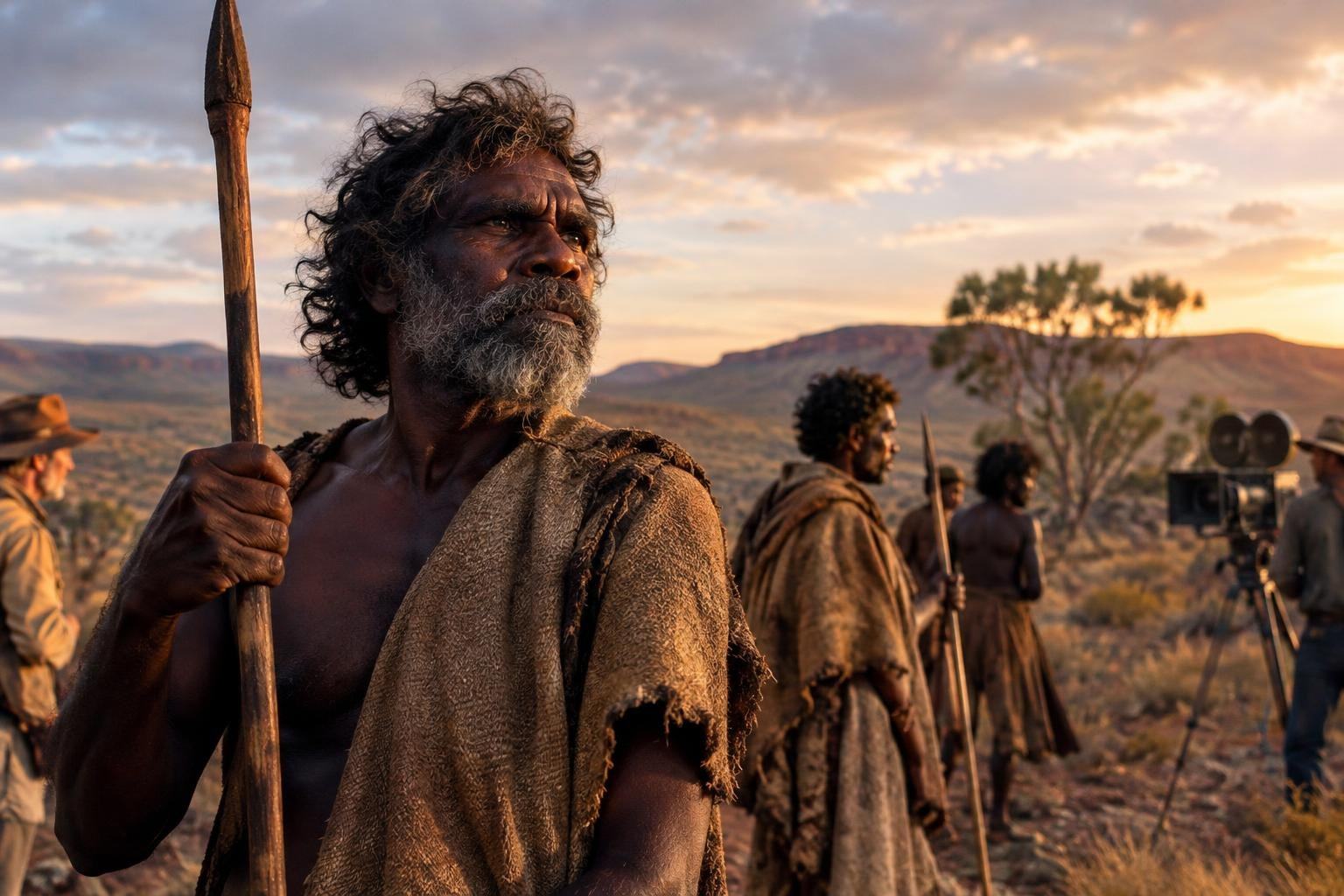
The most revealing dialogue in the 1950 Australian film Bitter Springs was never written for its script. Anangu performers, cast as members of a fictional tribe, were told to speak as the cameras rolled. For decades, their words were largely unintelligible to the filmmakers—and to most viewers. Now, a translation project is uncovering the history and sharp thinking carried in those scenes.
Among the film’s 120 Anangu performers was Thumu Pluto Hicks. His granddaughter, Vonda Last, recognised him the first time she watched the movie. Hicks had travelled for two days by train from his remote community to Quorn, in South Australia’s Flinders Ranges, where the production was filmed.
Last was seven when he died, but she knew him on screen straight away. She says the men in the film were senior figures, representing their strength and identity. Seeing them speak in language, she says, made her proud.
What the actors were saying all along
Bitter Springs follows Wally King, played by Chips Rafferty, as he attempts to settle land leased from the government. The film has been regarded as an early mainstream challenge to the story of the Australian frontier as an uncomplicated settler enterprise. Its Anangu performers, however, were placed in a fictional role and given no script.
The assumption was that they were making sounds without meaningful dialogue. Associate Professor Sam Osborne, an Aboriginal language expert at Adelaide University, is working with Iwiri Aboriginal Corporation and Pitjantjatjara and Yankunytjatjara interpreters to translate and subtitle the film. The work is complicated by dialects that are no longer spoken in the same way.
What the team has found, Osborne says, is improvisation that was thoughtful, inventive and responsive to the action. In one exchange, a white character demonstrates a rifle. An Anangu performer answers, in effect, that a bullet cannot travel over a tree or around a rock, while a spear can be used around a corner. The scene becomes more than a demonstration of a weapon: it is a quick, pointed comparison of its limits.
Another moment has a senior man raise his spear and call out “ma-pitija”—telling the settlers to go away. Such details change the viewing experience. The film’s English-speaking audience may have followed the settlers’ story, but the Anangu performers were also shaping what was happening in a language the production did not understand.
A family history on screen
The project also helps reconnect the film with the people whose lives it entered. Social anthropologist Maggie Brady, who has worked with communities around Yalata, Oak Valley, Maralinga and the Anangu Pitjantjatjara Yankunytjatjara lands for decades, heard locals refer to the years before the British nuclear tests at Maralinga as “Bitter Springs time”. The tests began in 1952, two years after the film was made.
Brady’s research took her to Quorn, where local historical photographs helped families identify parents and grandparents—even when those relatives had been children at the time. Copies of photographs and the film were taken back to communities. For Last, the movie is not simply an old production or a piece of Australian cinema history: it is a record of her grandfather and of people speaking on their own country.
The film’s production brought Aboriginal performers from remote parts of South Australia and Western Australia to Quorn. While the white stars stayed at the town’s Transcontinental Hotel, the Anangu performers were housed at a campsite near the locations. That contrast is part of the history the translation work makes newly visible: the people who contributed to the film were not afforded the same recognition as its famous leads.
Giving the film a different kind of premiere
In May, Illuminart presented a 30-minute documentary about the production, projecting it onto grain silos in Quorn. The company has joined the effort to translate and subtitle Bitter Springs in full, with the aim of showing it at future Australian film festivals. That work is still underway; a fully translated version and festival screenings are ambitions, not completed events.
The value of the project is not just that it adds subtitles to an old film. It changes who gets to be heard in it. What once seemed like background noise turns out to be commentary, argument and memory—and a reminder that a scene can contain more than its directors know they have filmed.