
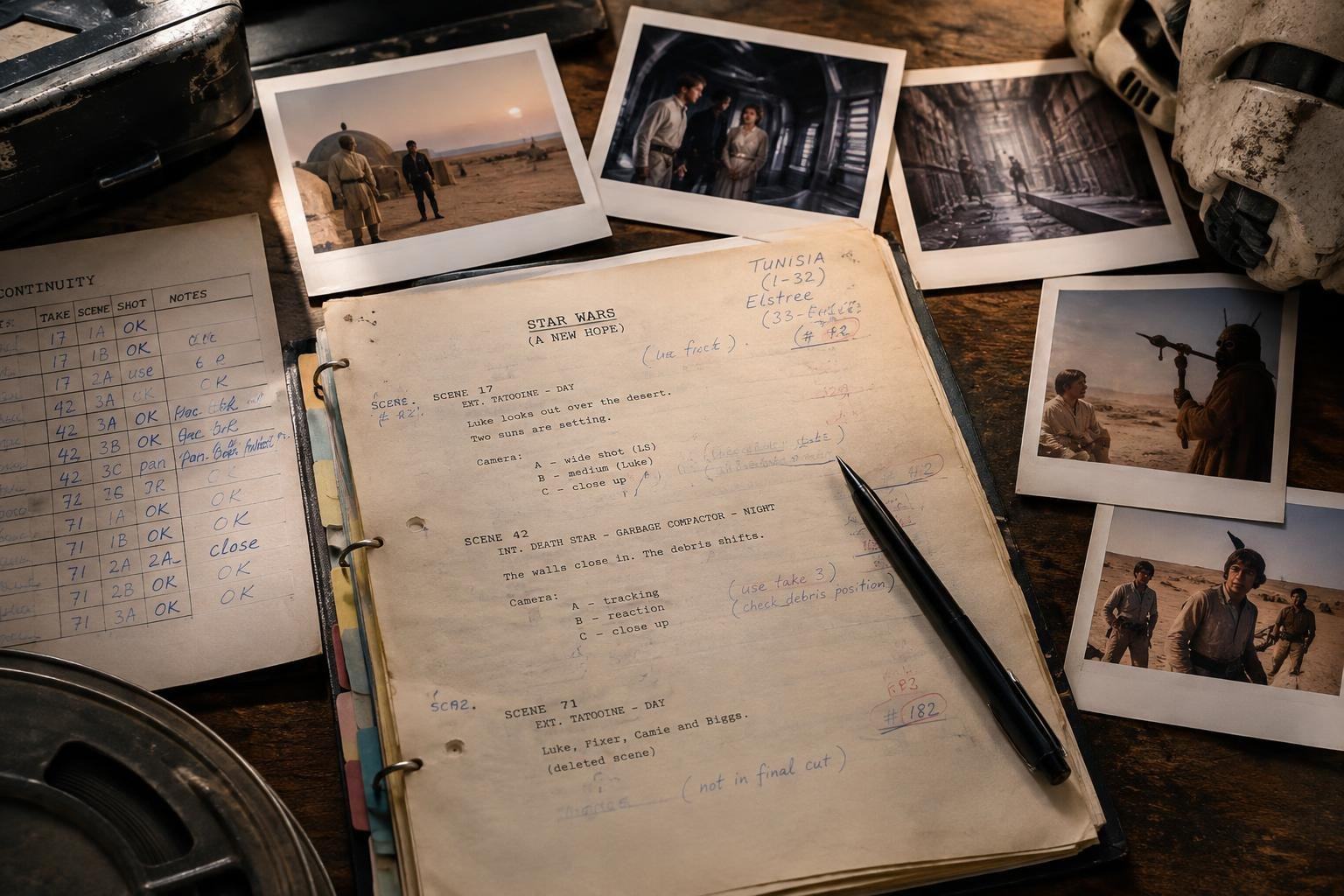
Before Star Wars became a galaxy-spanning adventure, it was a production full of practical puzzles: which prop belonged in a scene, where a character stood, and how a set should look when filming resumed days later. A script preserved in the BFI National Archive offers an unusually vivid record of how those details were tracked during the making of Star Wars: Episode IV – A New Hope.
The script belonged to continuity supervisor Ann Skinner. Its pages are crowded with handwritten notes, shot references and Polaroid photographs from the 1976 production. Together, they reveal not just what the filmmakers planned, but the careful work needed to make scenes shot in different places and at different times fit together.
The behind-the-scenes job that helps a film cut together
Continuity supervision is one of filmmaking’s less visible roles, but it has a direct effect on what audiences see. Films are seldom shot in the order their stories unfold, so someone must keep track of details that could otherwise shift between takes: an actor’s position, a costume’s state or the placement of an important object.
Skinner described her role as “the editor’s agent on the studio floor; the intermediary between the director and the editor”. Her script shows what that meant in practice. Before filming, she timed the script, checked the order and timing of scenes, and noted props that would be needed. During the shoot, she recorded takes, changes to dialogue and information that could help the editor assemble the footage.
Even the marks on a page tell a production story. Lines and numbers identify camera set-ups and slate references, helping connect the written scene to the footage recorded on set. Early numbers correspond to work in Tunisia, where the desert landscapes stood in for Tatooine; later ones point to filming at Elstree Studios in Hertfordshire.
Polaroids turn production notes into snapshots
The photographs are more than keepsakes. Stapled beside the relevant script pages, they captured details quickly while filming was underway: the position of performers and props, the arrangement of costumes, or the changing appearance of a set. In an age before digital images could be checked instantly, a Polaroid offered a practical visual reference.
That record mattered in scenes where the surroundings themselves changed. When Luke, Han and Leia are trapped in the garbage masher aboard the Death Star, the walls and debris shift as the danger escalates. Skinner photographed the set at different stages, linking its changing state to moments in the action. Those images helped preserve the visual progression, so the sequence could feel continuous rather than like pieces filmed at separate times.
Other pictures document rehearsal and different takes for Luke’s encounter with the Sandpeople, also known as Tusken Raiders. At the end of each day, Skinner prepared continuity sheets for the editor, including information about which takes George Lucas wanted to use. The script was therefore both a working document and a communication tool linking the set to the editing room.
What the finished film left behind
The pages also preserve material that did not survive into the released film. Among the scenes in the shooting script are additional moments on Tatooine with Luke and his friends Fixer, Camie and Biggs. Biggs later appears as a Rebel pilot in the assault on the Death Star, making the earlier material a glimpse of a wider version of the story than audiences ultimately saw.
There are less formal glimpses, too: photographs of actors away from their familiar screen personas, including David Prowse without Darth Vader’s helmet. These images make the distance between the mythic finished film and the people working on its production feel suddenly small.
A New Hope is remembered for its imagined worlds and groundbreaking effects, developed by Industrial Light & Magic in California alongside work by crews in Britain and Tunisia. Skinner’s annotated script reveals another kind of craft beneath that spectacle: the steady accumulation of observations that let a complicated production become a clear, legible movie. The galaxy may have felt far, far away, but getting every detail to match was a very grounded job.