
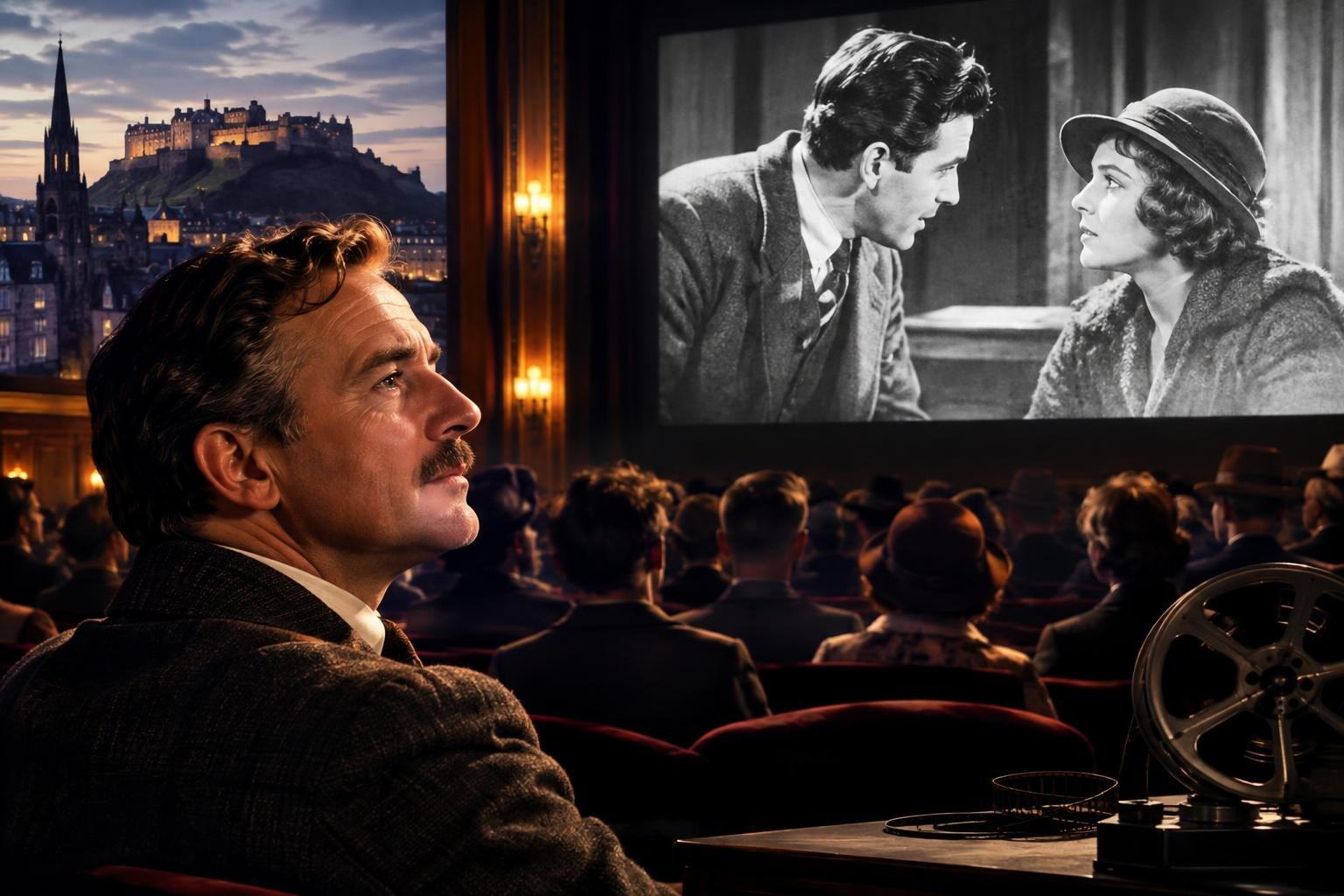
Hollywood’s sound revolution is usually given a familiar starting point: The Jazz Singer, the 1927 hit that helped turn talking pictures into the industry’s future. But a year earlier, cinema-goers in Edinburgh had already heard a feature-length film with synchronised dialogue. Its name was Till the Bells Ring, and its place in film history is a reminder that being first and being remembered are not the same thing.
The 44-minute Scottish production made its public debut on 11 October 1926 at Poole’s Synod Hall, near Edinburgh Castle. According to the film’s history in the BFI National Archive, it was the first time a cinema had presented a programme with a main feature containing synchronised sound and dialogue throughout. The venue’s bold billing called it “The Last Word in Talking Pictures”.
A science-fiction writer turns sound into drama
The film’s director, Graham Moffat, had imagined talking pictures decades before he made one. In 1893, aged 27, the Glaswegian clerk published What’s the World Coming To?, a novel set in 2003. One scene takes place in a cinema where audiences watch and listen to performances by actors who have long since died—a striking idea at a time when projected films had yet to arrive.
By the 1920s, Moffat was a successful Scottish playwright and an early investor in De Forest Phonofilms. The company had brought its sound-on-film operation to a small studio in Clapham, London, in 1923. Its work largely focused on short films, but Moffat saw a bigger possibility: using the technology for sustained dramatic storytelling. He hired the studio in December 1925 to make Till the Bells Ring, adapting one of his plays.
In technical terms, the film anticipated the format that would soon become standard: a feature-length story with dialogue and sound running throughout. The BFI and the American Film Institute count films over 40 minutes as features, putting the film’s estimated 44-minute runtime over that threshold. The estimate is based on its recorded physical length; a slower projection speed could have made it closer to 48 minutes.
Why the first audiences mattered
The response was far from an instant triumph. A private screening at London’s Holborn Empire music hall was met with indifference, with a technical fault reportedly making part of the film unintelligible. Some London film commentators were also unconvinced by the prospect of sound features. One enthusiastic response came from a writers’ publication, but film-industry insiders dismissed its praise.
Edinburgh audiences, by contrast, found a way into the film through its comedy and “broad Scots dialogue”. One newspaper singled out a joke from a reverend character: “What wid the Kirk o’ Scotland dae withoot peppermints?” The significance was more than local colour. A voice and a familiar turn of phrase helped listeners stop concentrating on the novelty of recorded speech and start responding to the scene itself.
That is a small but revealing lesson in how new screen technology wins people over: not through its specifications alone, but when it makes a story feel immediate. In this case, the evidence of progress was a laugh.
A milestone that slipped from view
The Jazz Singer became the landmark title, though it was not an all-talking film. Till the Bells Ring was. The BFI account notes that the Scottish production’s cinema screenings came a year before the Hollywood film, and that it preceded Lights of New York (1928), often regarded as the first all-talking feature from the United States. Yet Moffat’s film had only a brief public life. Three of its four reels survive in the BFI National Archive, but it has not had a cinema screening since an unauthorised reissue in 1933.
Britain did not quickly follow Moffat’s lead. It was not until 1929, after Hollywood’s talkie boom had changed expectations, that British filmmakers scrambled to record dialogue or adapt silent films into hybrid versions. It is tempting to imagine what might have happened if Till the Bells Ring had been embraced sooner, but that remains a counterfactual, not a lost history we can prove.
What can be said is that a Scottish playwright made a feature that anticipated the sound era, then watched the industry take years to catch up. The story complicates the usual Hollywood-centred account: cinema’s next big idea was already speaking in Edinburgh, even if the world was not yet listening.