
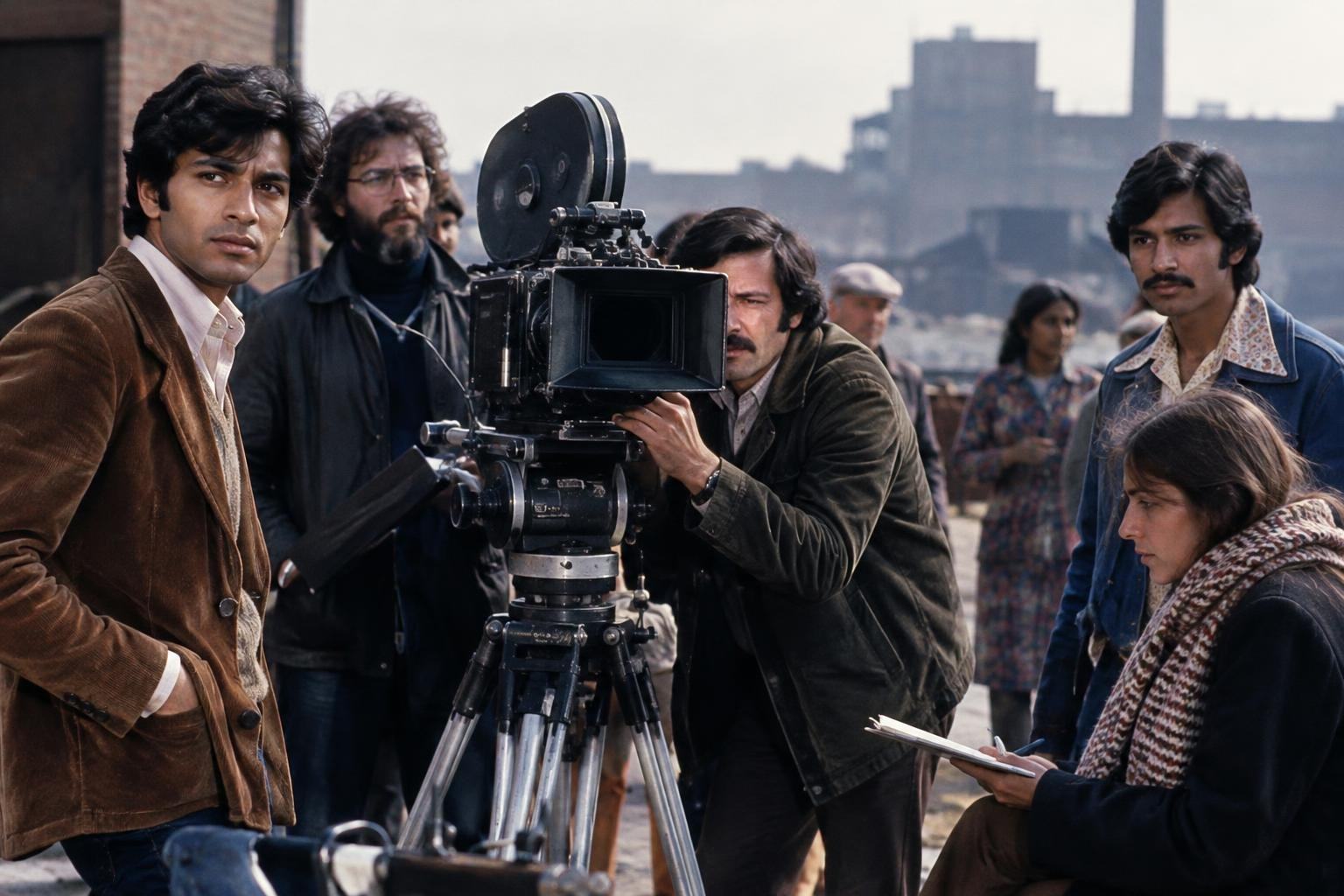
At first glance, the photographs could be from almost any earnest, low-budget production of the 1970s: flared jeans, heavy moustaches and a crew intent on the work. Look closer, though, and they become a record of a significant moment. The film being made is A Private Enterprise, generally regarded as the first British Asian feature film.
The images, highlighted by the BFI, show a production taking shape in 1974. Their importance lies not in spectacle but in what they preserve: a British Asian story being made at a time when such experiences were largely absent from British feature films. The stills turn an archival glimpse of a film set into evidence of a new perspective entering the frame.
A young man trying to find his footing
Directed by Peter K. Smith, A Private Enterprise was written by Smith with writer and commentator Dilip Hiro. Its central character, Shiv, is an engineering graduate from the Indian subcontinent, played by Salmaan Peerzada, credited as Salmaan Peer. He is trying to build a life in 1970s Birmingham, where workplace politics and the promise of running his own business pull him in different directions.
Shiv works in a factory alongside his flatmate Ashok, played by Marc Zuber, but dreams of making and selling Indian trinkets. The small business ambition gives the film its title—and makes the story more than a simple account of a newcomer finding work. Shiv is trying to decide what kind of future belongs to him, while negotiating the expectations of family, colleagues and the people he meets.
That search takes him through settings where he often seems out of place: dance lessons, a white middle-class house party, union gatherings and awkward dates. The BFI’s account compares his uncertainty to that of Benjamin in The Graduate, but Shiv’s difficulties are shaped by more than the general disorientation of youth. The film also confronts the racism he encounters in his adopted country.
The details that make the story resonate
Some of the film’s sharpest observations come through its relationships. An early meeting on a train with student Penny, played by Diana Quick, hints at a connection, but their romance falters. Shiv eventually recognises that Penny may see him less as a partner than as an adventurous novelty. It is a quiet disappointment, but one that exposes the unequal terms on which their attraction rests.
There is a different kind of mismatch in Shiv’s encounter with Chandra, played by Shukla Bhattercharjee. His uncle Ramji, played by Ramon Sinha, sees her family’s business standing as a reason they might make a suitable match. Shiv, however, is put off by her materialism. The contrast helps the film resist an easy split between tradition and modernity: the people around Shiv have their own competing ideas of success.
The ending brings the larger tension into focus without turning it into a speech. On a train, Shiv smiles at a baby; the child’s mother turns the baby away. The gesture is brief, but it makes visible the racism that underlies the everyday encounters the film has been tracing. Its restraint is part of its force: the moment leaves viewers with the sting of an ordinary interaction made exclusionary.
Why the photographs matter now
A Private Enterprise was made on a micro-budget through the BFI Production Board, then headed by Mamoun Hassan. The BFI has linked the film to Hassan’s belief that British cinema should be rooted in what is happening around it. That principle is evident in a story grounded in Birmingham life, work, ambition and the social barriers Shiv faces.
Production photographs can make film history feel tangible: a scene is being arranged, a crew is concentrating, and an idea is becoming an image. Here, they also invite a broader question about whose lives get to count as part of the national screen story. The achievement preserved in these pictures is not simply that a film was made, but that a British Asian perspective was given room to shape one. The stills remind us that representation has a history—and that sometimes its turning points look, at first, like an ordinary day on set.