
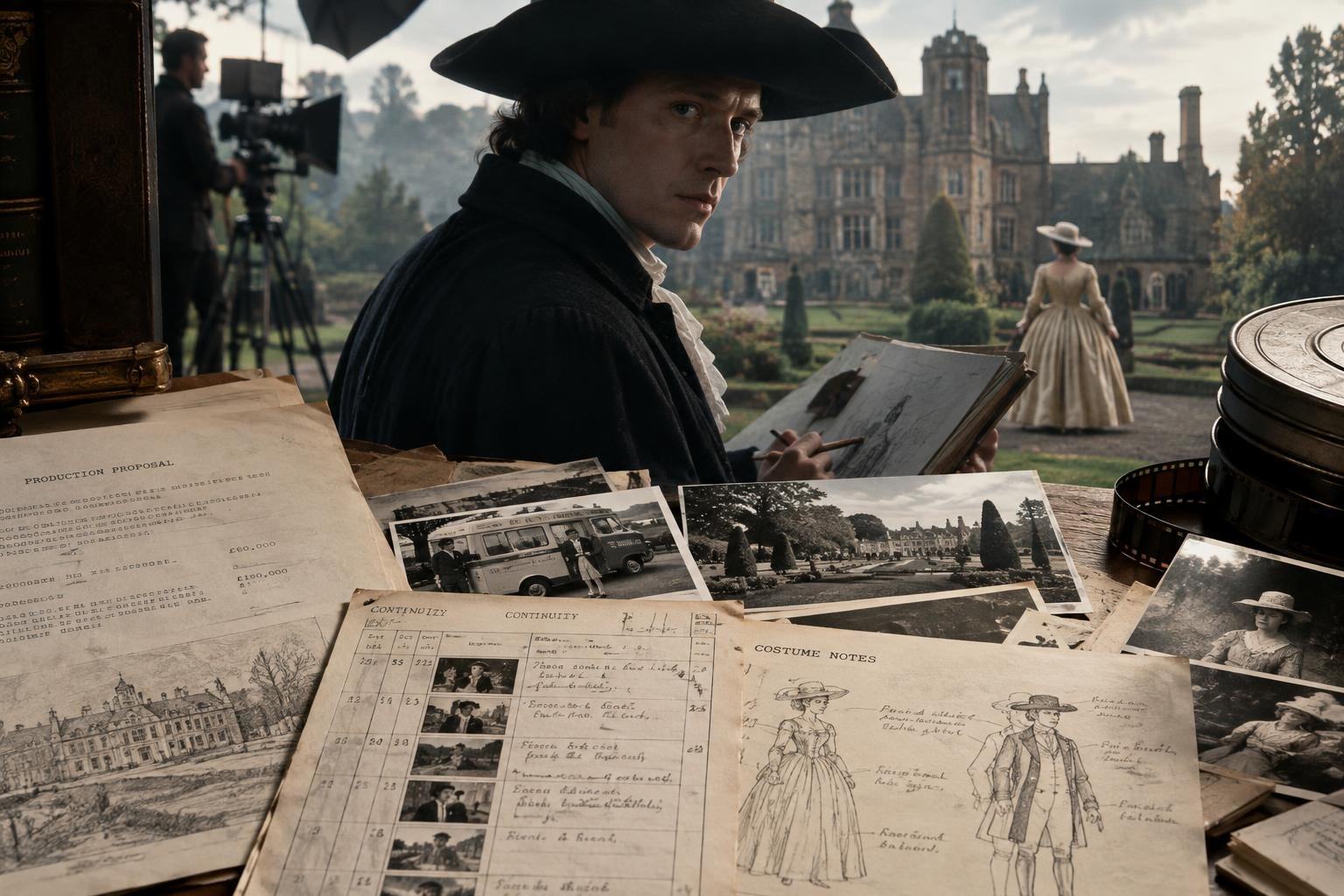
In The Draughtsman’s Contract, a draughtsman sets out to record a country estate in meticulous drawings. The film’s own production, it turns out, was just as carefully planned—and frequently interrupted. Documents preserved in the BFI National Archive offer an unusually vivid view of how Peter Greenaway’s first narrative feature moved from an ambitious proposal to a distinctive screen world.
The archive material came into focus in 2022, when a 4K restoration was shown on British screens close to the film’s 40th anniversary. Released in November 1982, the period mystery was praised for its striking compositions and went on to run for six months at one London cinema, even continuing after its television broadcast on Channel 4, one of its funders. The papers help explain not just how the film was made, but how its visual precision was built out of practical compromises.
A modest proposal becomes a landmark production
Greenaway initially asked the BFI Production Board for £60,000. His plan was to shoot on black-and-white 35mm film and print onto colour stock, creating what he described as a visual equivalent to the draughtsman’s black marks on white paper. The production ultimately received £150,000 from the BFI, matched by the newly formed Channel 4 in return for broadcast rights.
The leap from Greenaway’s earlier work was substantial. The BFI had already supported A Walk Through H and The Falls, but The Draughtsman’s Contract was a full-scale production with professional actors. The film’s eventual look also changed along the way: cinematographer Curtis Clark shot on Super 16mm colour stock. That evolution is a reminder that a director’s first plan may be a guiding idea rather than a blueprint that survives untouched.
Production Board head Peter Sainsbury had encouraged Greenaway to make a feature. On reading the script, he later said it seemed Greenaway had been waiting for the BFI to catch up with him. The project brought together a team whose members—including casting director Lucy Boulting, art director Bob Ringwood and costume designer Sue Blane—would go on to long careers.
Period detail, made on a shoestring
The choice of location was central to the film’s composed, estate-bound atmosphere. Stanway House in Gloucestershire was considered, but Groombridge Place in Kent became the setting. Its owner agreed to host the production on the condition that the house’s name and precise location would not appear in the credits. The crew kept that promise, even as viewers tried to identify the place.
Greenaway was not aiming for strict historical reconstruction. In his pressbook comments, he compared the period film’s world-building demands with those of science fiction, while saying that he had taken stylistic liberties rather than chasing a supposedly perfect realism. Blane’s costumes reflect that approach: they are deliberately more extravagant than everyday late-17th-century dress might have been. With money tight, she used inexpensive calico to create lavish-looking garments.
The garden’s carefully arranged appearance was similarly resourceful. A limited supply of wooden obelisks and bay trees was moved around the grounds to create different compositions. The result is a film that can feel lavish, though the archive reveals how much of that effect came from making a few elements work hard.
When the interruptions enter the picture
Daily continuity sheets record the less stately side of filming: ice-cream vans, aircraft, trains and boilers sometimes forced retakes. Groombridge Place lay beneath a Gatwick flight path, and the ordinary sounds of the world could intrude on a carefully staged scene. The documents also preserve small performance slips. One Anthony Higgins substitution—“roberoom” for “wardroom”—was kept in the finished film, apparently because Greenaway liked its alliteration.
There is a neat connection between those disruptions and the film’s underlying idea. Greenaway had begun sketching different parts of a house in 1976, but his efforts were repeatedly diverted by people, sheep, meals and children drawing. Those distractions fed into the finished story, which is interested in the distance between an orderly plan and everything that refuses to stay within it.
The BFI papers also show that Greenaway’s original prologue was much longer than the version audiences saw. It was cut down with editor John Wilson to eight minutes so the plot could begin sooner; a story involving Greenaway’s recurring character Tulse Luper did not make the final cut. That lost material is a useful counterpoint to the film’s controlled surface: even a director fascinated by systems had to decide what to leave outside the frame.
Four decades on, the archive makes the film’s precision feel less like perfection than a series of choices—about money, sound, fabric, framing and time. The drawings in The Draughtsman’s Contract promise to capture a place exactly. Its production papers reveal the more intriguing truth: the picture was shaped as much by what interrupted the plan as by what followed it.