
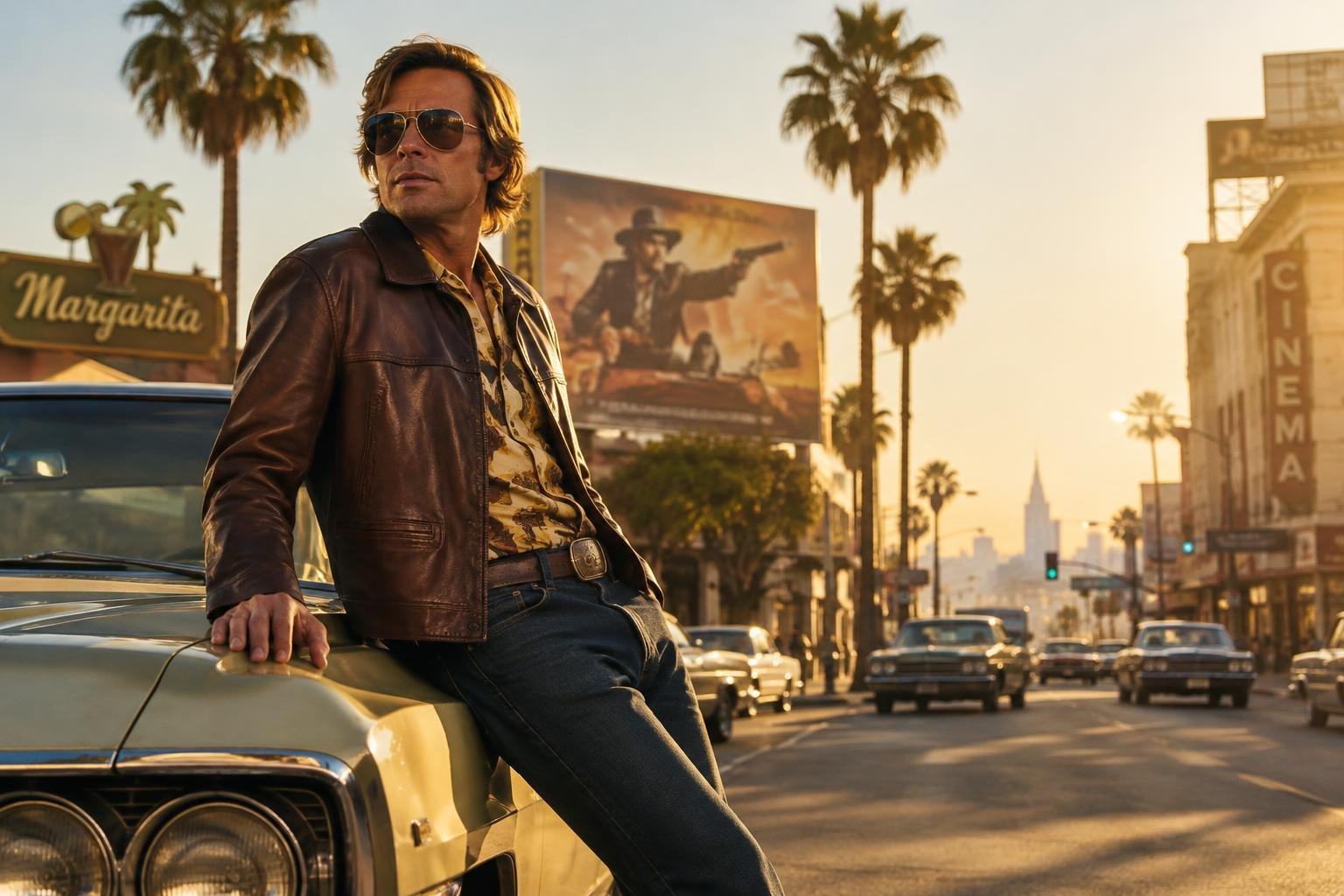
A sequel to Once Upon a Time in Hollywood could have tried to recreate the earlier film’s sun-baked tension. The Further Mis-Adventures of Cliff Booth takes a different route: it lets Brad Pitt’s stuntman drift through a week in Los Angeles, where old Hollywood habits linger and the future is already changing the business.
The film is written by Quentin Tarantino and directed by David Fincher. In Variety’s review, that pairing becomes the movie’s defining contrast: Tarantino supplies the digressions and period pop, while Fincher’s precision keeps the freewheeling material on a steady course. The resulting mood is less a tightly wound thriller than a carefully controlled hangout—easygoing on the surface, with violence never far away.
A Hollywood in the gap between eras
The story unfolds in the latter part of 1977, shortly after Star Wars began reshaping the movie landscape. The review reads that timing as more than period decoration. The counterculture has ebbed, the old studio-era glamour feels distant, and Hollywood is waiting to find out what comes next.
That uncertainty gives the film’s nostalgia a useful complication. It savours disco, ELO and a gloriously tacky margarita bar, but the affection is not entirely solemn. An opening film-within-the-film, Soul Brothers Die Hard!, offers a loud, blaxploitation-flavoured slice of entertainment, while the closing credits reportedly roll to Boz Scaggs’ “Lowdown.” The soundtrack and scenery are not just reminders of 1977; they help create a world happily marinating in its own excess.
Even the arrival of Star Wars matters to the movie’s sense of industry change. Rick Dalton, Cliff’s former employer and friend, has moved to Australia to star in a television series called Dingo Dan. An Oscar statuette among the items stolen in one episode is treated as a relic of a fading order. Meanwhile, Cliff’s next job connects him to Charlie Peters, a flamboyant television star whose career spans Westerns and combat shows.
Cliff’s greatest stunt is making danger look easy
Cliff is older now, with aching joints, a slight limp and fewer steady jobs. He lives with his father, played by Peter Weller, and patches together work—including shifts as a projectionist at the New Beverly Cinema. But the review’s central pleasure is that none of this seems to trouble him very much. He remains calm, charming and entirely at home in his own skin.
Pitt’s performance, as described in the review, leans into that contradiction. Cliff is polite and approachable, but also so unbothered by violence that a confrontation can turn abruptly lethal. The movie’s opening episode makes the contrast clear: after screening Soul Brothers Die Hard!, Cliff handles a thief and his unwitting companion with a coolness that is both startling and darkly comic. His relaxed manner is not a lack of danger; it is the thing that makes him dangerous.
That ease also gives the character an unusual kind of star power. The review highlights his weathered charm, his confident presence and the way he can read a room without seeming to work at it. Cliff may be approaching 50 and living on odd jobs, but he has not lost the effortless magnetism that made him memorable in the first place.
Television is hiding in plain sight
For all its attention to movie history, the film’s world is increasingly shaped by television. Rick has gone to Australia for a series; Charlie Peters is a star of TV Westerns and action shows; and Cliff’s work keeps moving between screens, sets and Hollywood backrooms. That makes the movie’s meandering structure feel purposeful: its subject is a town where careers, identities and entertainment formats are all in transition.
There are also nods for viewers who know Tarantino’s screen universe, including a Red Apple cigarette commercial featuring Margot Robbie as Sharon Tate. But the film’s larger interest, according to the review, is not simply in spotting references. It is in watching Cliff move through a Hollywood that has plenty of spectacle and no clear destination.
The title promises more adventures, but the film’s appeal seems to lie in the mis-adventures: the odd jobs, chance encounters and low-stakes diversions that reveal a character better than another grand showdown might. Its most telling image may be Cliff, still cruising through a changing town, apparently unconcerned about what comes next. In a story about an industry chasing its future, his gift is living completely in the present.