
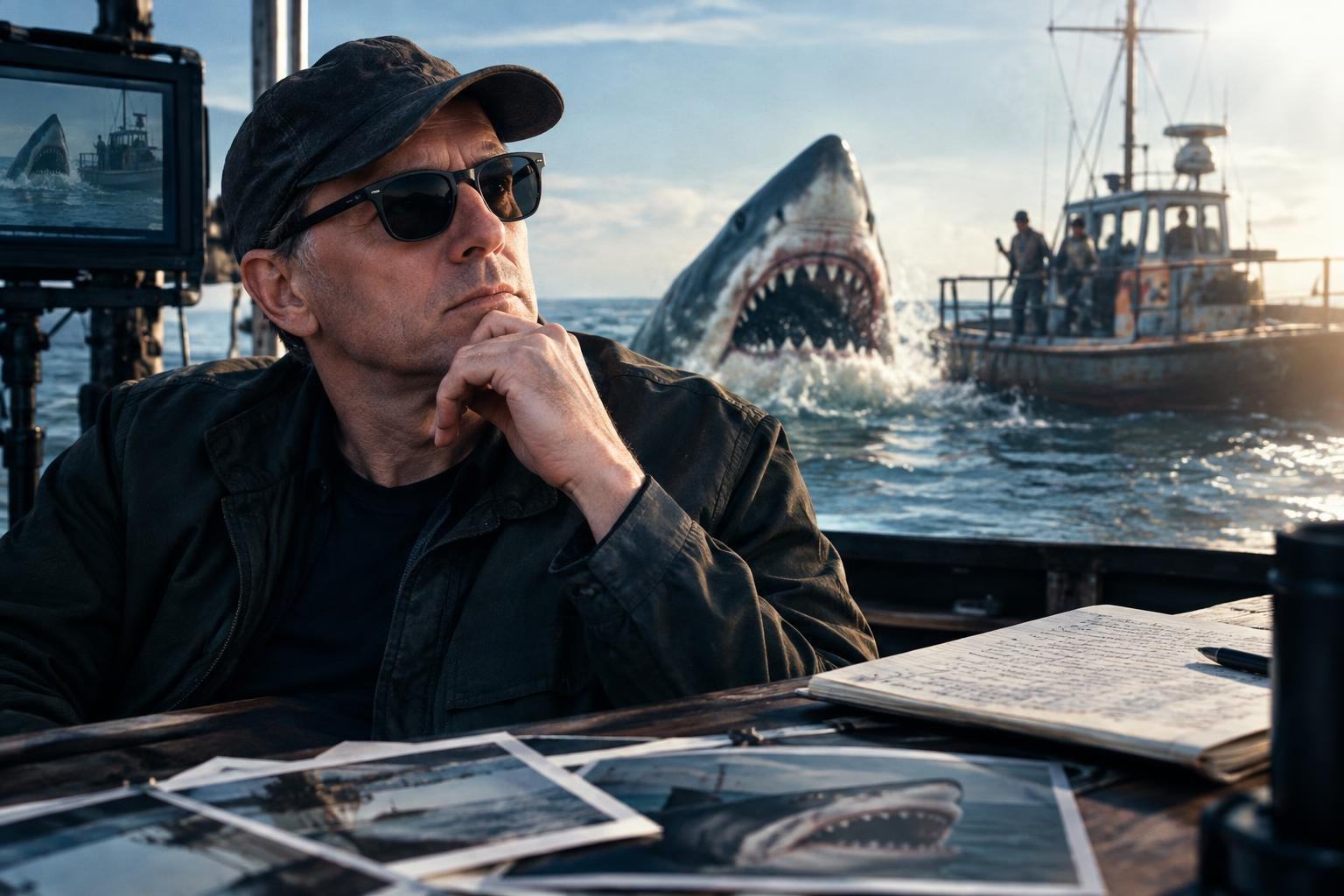
Some films become classics because everything went according to plan. Jaws is a more instructive case: its mechanical shark repeatedly failed, the script was still evolving, and the shoot became a notorious ordeal. For Steven Soderbergh, that chaos is part of the lesson—and one reason he says the film improves every time he watches it.
In a new interview with Sight and Sound, the director of Erin Brockovich and Black Bag describes Steven Spielberg’s 1975 thriller as a kind of filmmaking syllabus. He has studied it for years and is now working on a book about the film as a way to explore the craft of directing. No publication date is announced; the project, he says, has recently begun to feel like a real book rather than an idea.
The broken shark became part of the storytelling challenge
The production’s famous mechanical-shark problems can sound like a story from another era of moviemaking. Soderbergh’s point is that the underlying challenge has not gone away: putting a large mechanical creature in the ocean and making it behave convincingly still means contending with water, weight and physics. New technology does not make those forces disappear.
In his view, Spielberg’s response matters as much as the malfunction itself. Soderbergh has examined production reports and script-supervisor notes from the shoot, and says they record a stretch when the crew had reason to wonder whether the central idea could be filmed at all. Spielberg was still an early-career director, not yet the industry figure he would become, and the scale of the production’s difficulties was drawing attention.
What Soderbergh finds admirable is not a magical solution but a refusal to panic. The production moved forward while Spielberg kept adjusting the film, trying to identify what could work and what the story required. The takeaway is less “every crisis makes a great movie” than a director must keep judging the film in front of them, not simply defend the plan they started with.
Why the movie works as a directing lesson
Soderbergh calls Jaws a compact demonstration of filmmaking’s basic ingredients: brisk and sustained shots, comedy alongside suspense, character scenes alongside action. That variety is not just a checklist. The film’s shifts in pace and tone help make its danger feel both human and physical, giving the audience something to care about before the threat takes over.
He also credits the performances of Roy Scheider, Robert Shaw and Richard Dreyfuss with helping sustain confidence in the project. But he argues that the film ultimately depends on the filmmaking itself—and on John Williams’s score, including the supporting music beyond its instantly recognisable theme. In other words, the effect comes from elements working together, not from one famous musical cue or one spectacular scare.
That perspective offers a useful way to think about directing: a film’s needs can diverge from what its makers initially want. Spielberg has said he never again began a shoot without a script he considered locked, a change that underlines how exceptional the circumstances of Jaws were. Soderbergh’s admiration is not an endorsement of making a movie without a settled script; it is a study of how clear storytelling instincts can help a filmmaker navigate a production that has lost its footing.
A hit, a bestseller and an unpredictable cultural moment
Soderbergh also points to the pressure surrounding the film’s release. Jaws was adapted from a hugely popular bestseller, so audiences already knew the story and expectations were high. The film exceeded those expectations, he argues, producing a cultural impact that cannot simply be manufactured by assembling the right ingredients.
That may be the most lasting appeal of his fascination. Jaws is both a carefully constructed piece of entertainment and a reminder that filmmaking is a practical art, shaped by limits as much as by ambition. Soderbergh is still looking for answers in its edits and decisions. For the rest of us, the enduring question is simpler: when a plan breaks, can you still recognise what the story needs?