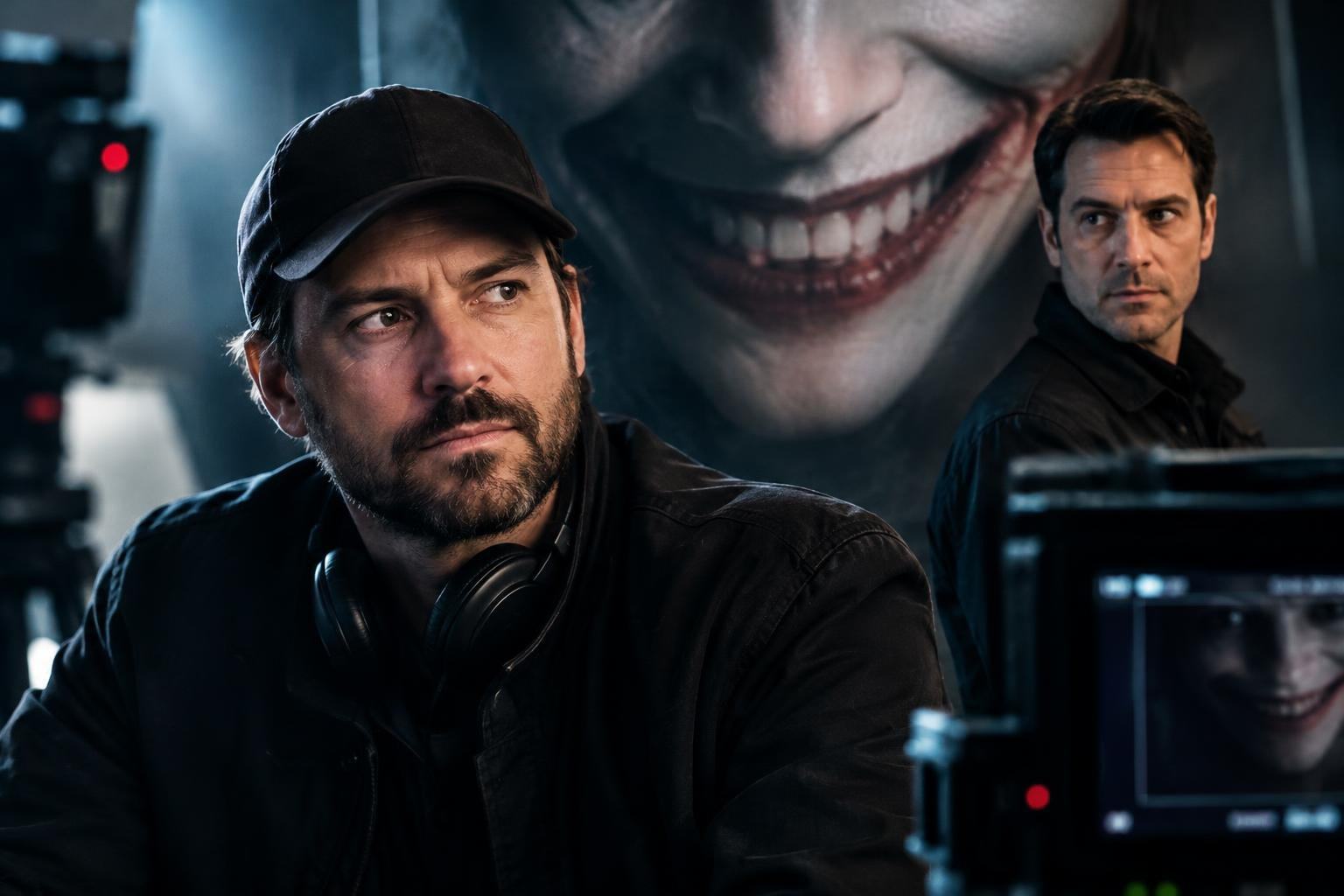
The smile is staying; the filmmaker behind it is changing. David Bruckner is set to direct “Smile 3,” taking over from franchise creator Parker Finn, who will remain involved as a producer alongside Temple Hill Entertainment.
The handoff gives the next instalment a director with a substantial horror résumé, while keeping Finn connected to the series’ development. Nick Antonsca will write the screenplay from a framework developed by Finn, with Jonathan Fass serving as executive producer. No plot details are included in the production information available here, so the creative shift—not a promised new direction for the story—is the clearest early clue about what the sequel might bring.
A horror director with a taste for the uncanny
Bruckner’s career has moved between anthology horror and feature films. He directed segments in projects including V/H/S and Southbound, and was among the filmmakers behind the 2007 Sundance film The Signal. That background matters for a franchise built around a simple, repeatable image: a smile that turns an everyday expression into a source of dread.
His later features offer a more direct sense of his range. The Night House, released by Searchlight in 2021, uses grief and an unsettling domestic setting as the basis for its horror; his 2022 reimagining of Hellraiser revisited one of the genre’s more established worlds for Hulu. Those credits make him a natural fit for a sequel that needs to work within a recognisable horror property, although they do not tell us how he will approach Smile 3.
Bruckner also has other projects in development, including a Blob remake for Warner Bros. and an adaptation of Marcus Kliewer’s novel The Caretaker starring Sydney Sweeney for Universal. They underline the steady demand for filmmakers who can work with horror’s familiar ingredients while finding room for a distinct mood or perspective.
Why the series has room to evolve
The first Smile became a breakout hit after premiering at Fantastic Fest in 2022. It grossed $217 million worldwide, making it the highest-grossing original horror film of that year, according to the supplied production information. Its 2024 follow-up brought in $138 million worldwide—evidence that audiences continued to turn out for the premise, even as the franchise moved beyond its opening chapter.
Those totals are not a guarantee of what a third film will earn, and box-office success does not reveal exactly what viewers want next. But they help explain why the series is continuing—and why the creative handoff is worth watching. A horror sequel must preserve enough of its original identity to feel like part of the same story-world, while giving audiences a reason to return. Bringing in a new director is one way to create that tension; Finn’s continued role as a producer and the screenplay’s basis in his framework offer continuity.
That balance is particularly relevant to a concept whose central image is instantly legible. The smile can travel from one character or situation to another, but repetition alone risks making the shock familiar. Bruckner’s anthology experience suggests a filmmaker accustomed to working within horror’s compact forms, while his features show experience sustaining unease over a longer runtime. Whether those qualities reshape the series or simply extend its established approach remains an open question.
Finn’s next move points in another direction
Finn is not leaving horror behind. He is set to direct a remake of the 1981 cult film Possession, starring Callum Turner and Margaret Qualley. Paramount is due to release that film in June 2027 through a first-look deal, giving Finn a separate opportunity to lead a project of his own while Bruckner takes the reins of Smile.
For viewers, the most intriguing part of the announcement may be that the franchise is changing hands without cutting its creative connection to its originator. Bruckner brings a new directorial sensibility; Finn’s framework keeps the series’ creator in the conversation. The next smile, then, will have a different filmmaker behind it—but not an entirely new set of ideas.