
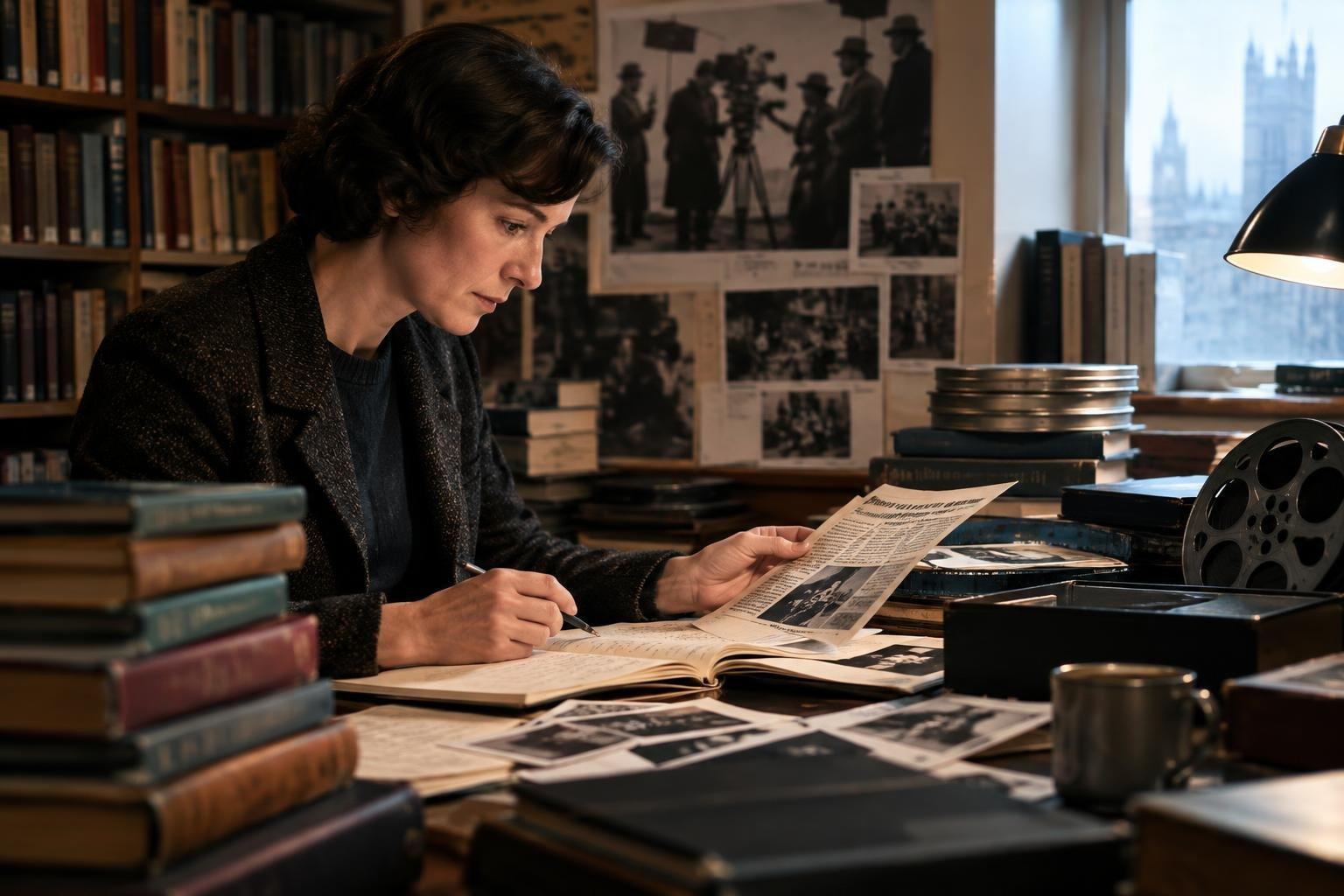
Film history can look like a matter of preserving great works. But it also depends on more painstaking questions: who made a film, under what conditions, and how did it reach an audience? British historian Rachael Low spent decades answering them, building a record of early cinema when the subject had little academic standing and its evidence could be hard to find.
Low died in 2014, but her passing attracted little notice in film-history circles. A 2018 gathering at the BFI Library helped renew attention to her work and its lasting value. The reason is not that every judgement she made has endured. It is that later historians have had a foundation to question, revise and build upon.
Making a history where the evidence was scarce
Low’s best-known achievement is a seven-volume history of British film, tracing the industry from 1896 to 1939. The first volume dealt with a particularly difficult stretch, 1896–1906: relatively few films from that period had entered the National Film Library, and contemporary accounts were limited.
Rather than treat those gaps as a reason to stop, Low sought out people who had been there. She interviewed filmmakers and incorporated their recollections into her research. That approach mattered: surviving films could show what audiences saw, but conversations with participants could help illuminate the people and practices behind them.
Low was also alert to less celebrated evidence. Her books drew on film-trade publications such as Kine Weekly and The Bioscope, using their reports to reconstruct an industry in motion. Professor Sarah Street later praised the books as models for building film-history narratives with empirical precision. Their appeal, she noted, lay partly in Low’s ability to make complicated events readable.
A long project, pursued across changing circumstances
Born in 1923, Low studied sociology and economics at the London School of Economics, graduating in 1944, and completed a doctorate in 1949 based on research for the first volume. She joined the BFI’s information department in 1945 and became part of a committee established the following year to research a comprehensive history of British cinema.
The first book was written with Roger Manvell. The next, covering 1906–1914, and the later volumes were Low’s alone. The project did not advance in a neat, uninterrupted sequence: after early financial support ended, Low resigned from the British Film Academy and spent years abroad with her husband. Later research was supported by a fellowship at Lucy Cavendish College, Cambridge.
That persistence produced more than a narrative of films. Low’s detailed credits and accounts of companies and personnel made it possible to follow careers, working relationships and shifts in production. Professor Christine Gledhill described those records as invaluable context for studying filmmakers and performers whose place in cinema history might otherwise be difficult to trace.
Why reassessing her work matters
Low was not outside her own era. As methods and priorities changed, later scholars revisited some of her assessments and challenged what earlier histories left in the margins. Gledhill, for example, valued Low’s research while questioning her sharp judgements of individual films and noting that women’s contributions did not always receive the attention they deserved.
That tension is part of Low’s significance, not a reason to dismiss her. Her work mapped an industry with remarkable detail, but its limits also show that no history is final. New questions can bring overlooked people and perspectives into view, even when the evidence has to be read against the assumptions of the historian who first assembled it.
Low’s books remain useful not as the last word on British cinema, but as an invitation to keep asking better questions. The history of a film industry is made not only on screen; it is also made by the researchers who preserve its traces—and by those who return to them with fresh eyes.