
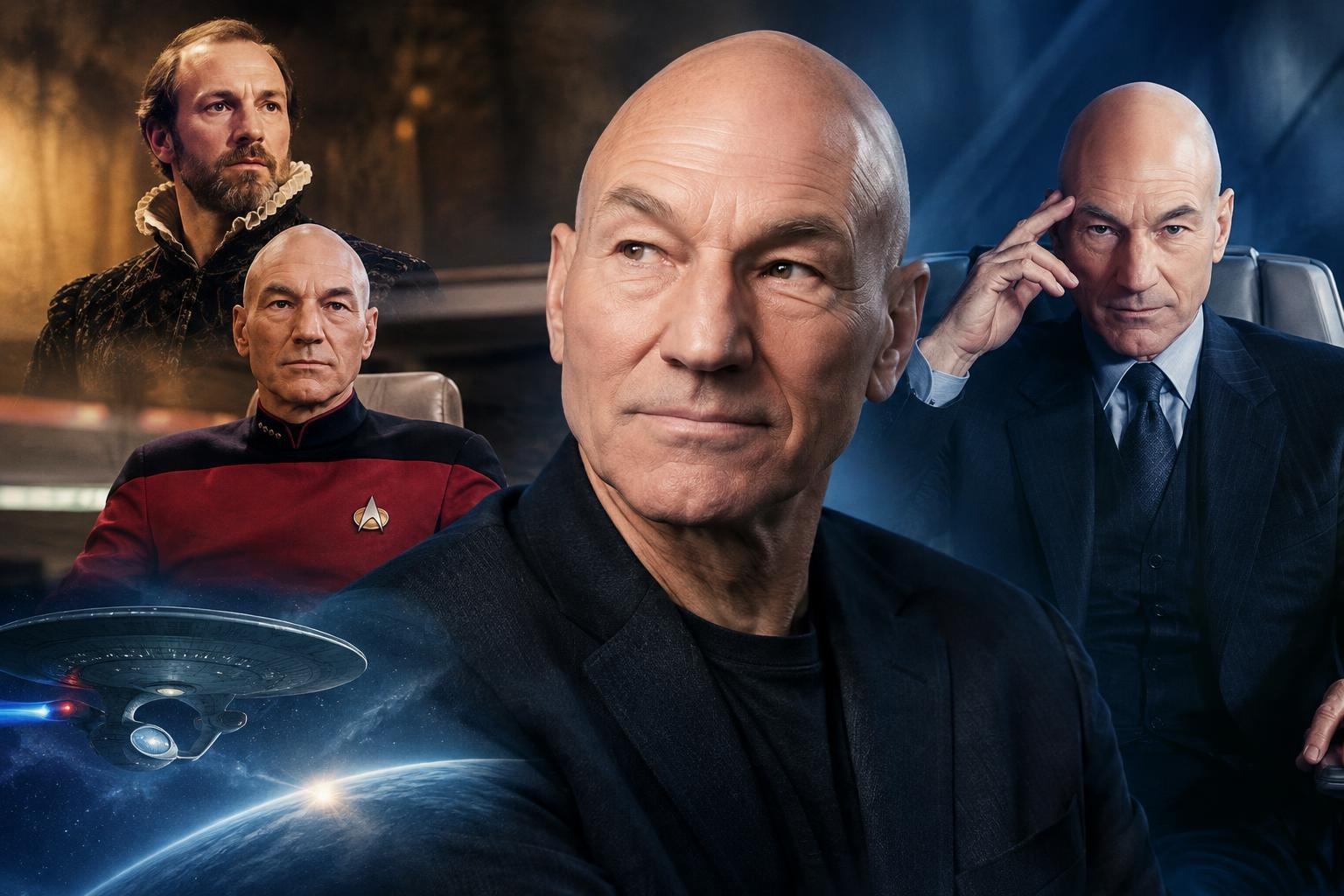
Patrick Stewart’s most famous characters could command a starship or lead a school for mutants. Their authority came from different worlds, but both carried a quality that defined the actor’s career: strength expressed through thoughtfulness, not bluster.
Stewart died Wednesday at his home in Los Angeles, aged 86, his longtime spokesperson Kelly Bush Novak said. She said he had experienced “a brief and poignant journey with Alzheimer’s disease and Lewy body dementia,” and that he was surrounded by family and friends.
How a Shakespearean became Captain Picard
By the time Stewart was cast as Jean-Luc Picard in Star Trek: The Next Generation, he had spent decades building a reputation on stage. Born in Mirfield, Yorkshire, he found an early refuge in acting, then trained at Bristol Old Vic Theatre School and joined the Royal Shakespeare Company in 1966.
His path to television stardom began through Shakespeare: while teaching master classes in Los Angeles, he came to the attention of a casting director. At 47, he took on the role of the Enterprise-D’s captain, a choice that initially seemed unexpected for an actor so closely associated with classical theatre. Across seven seasons, Stewart made Picard’s measured manner and firm decisions feel like a new kind of action-hero charisma.
“Make it so” and “Engage” became familiar commands, but the performance was more than a collection of catchphrases. Picard’s patience, curiosity and moral seriousness gave the science-fiction series a distinctive centre—and helped Stewart become a star around the world. He returned for four Star Trek films and later led Star Trek: Picard, which ran from 2020 to 2023.
Two icons, one actor
Stewart’s other defining screen role was Professor Charles Xavier, the idealistic mentor at the heart of the X-Men films. The casting paired his controlled intensity with a character whose influence depended on persuasion and empathy. Stewart appeared as Xavier in seven films, crossing into a different blockbuster universe without losing the theatrical precision that had first made his name.
His film work ranged well beyond science fiction and superheroes, including Jeffrey, Conspiracy Theory and the horror film Green Room, as well as voice roles in animated films. He is also expected to reprise Xavier in this December’s Avengers: Doomsday, according to the supplied announcement of his death. That appearance would give audiences another encounter with a character he helped make a fixture of modern screen culture.
Yet the scale of those franchises can obscure the range of Stewart’s work. He played Shakespearean roles including Macbeth, Othello, Prospero and Mark Antony, and earned two Laurence Olivier Awards, one for Antony and Cleopatra and another for Hamlet. His one-man A Christmas Carol, which he revived several times, brought another kind of intimacy to a career often associated with imposing figures.
A legacy built on craft—and generosity
Tributes from fellow performers reflected both sides of that legacy. Ian McKellen, Stewart’s friend and X-Men co-star, remembered his Yorkshire roots and his candour. Ben Kingsley recalled seeing him rehearse at the Royal Shakespeare Company, praising the “joyful, passionate commitment” he brought to the work.
Star Trek colleagues William Shatner and George Takei also paid tribute to the actor’s humanity and the hope his performances offered. Marvel chief Kevin Feige remembered a sharp sense of humour and a willingness to mentor others. Such recollections point to a career whose influence was not limited to the roles audiences saw on screen.
Stewart once described acting as a refuge from a difficult childhood. That early discovery helps explain the unusual through-line in his work: whether speaking Shakespeare or giving orders aboard the Enterprise, he made performance feel like a place where people could imagine better ways to live together. His characters may have occupied extraordinary worlds, but their most enduring power was recognisably human.