
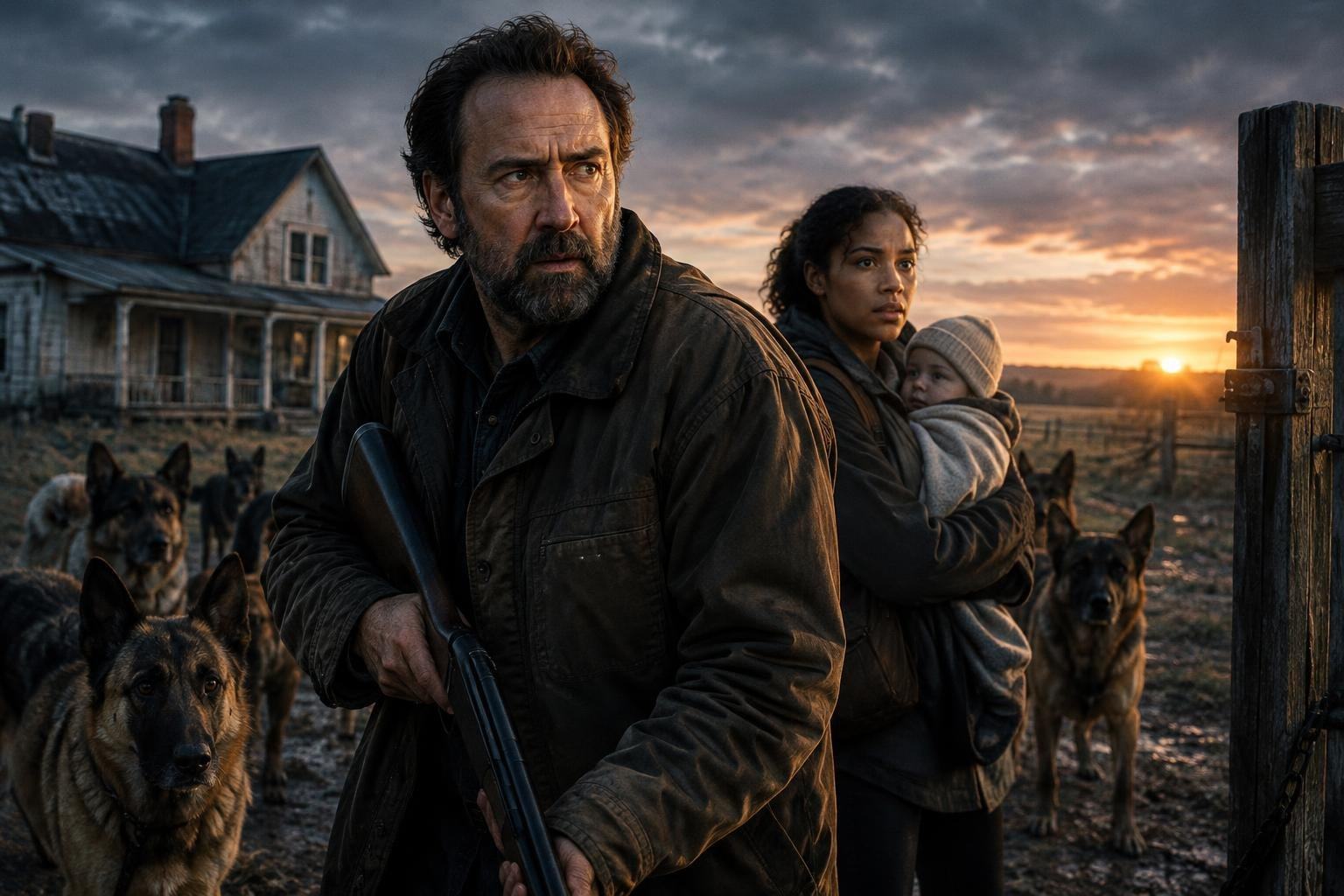
On a farm near Stillwater, Nicolas Cage plays a survivor who has made one rule for staying alive: keep everyone out. His character’s barricaded world is about to change when a woman arrives with an infant, bringing the danger he has tried to shut beyond his gates.
That is the setup for Parish, a post-apocalyptic thriller directed by Adam Sigal. The production, which also stars Alexandra Shipp, is scheduled to wrap filming on Thursday, according to the filmmakers. Sigal expects the movie to reach theaters in summer or fall 2027, though that is a forecast rather than a confirmed release date.
The shoot has another story running alongside the fictional one: Minnesota producers are making the case that a more generous film tax credit could help turn the state into a steadier home for movies and television.
A farmhouse, a fence and a pack of dogs
In the film, Cage’s character, Parish, has cut himself off on a farm, surrounded by walls and a pack of dogs. He refuses to let people through his gate because of creatures roaming outside. The arrival of a woman with a baby breaks his rule—and, as Sigal describes it, sets off a chain of chaos.
The production is using White Oaks Farm, a 320-acre property outside Stillwater, whose old house and outbuildings provide the story’s isolated setting. Dogs are part of the film’s appeal for Sigal, who has said that making a movie with a large canine cast was one of his inspirations. Among the animals expected on set is Nala, a Belgian Malinois who also appears in Fallout.
The details give Parish a familiar but flexible genre hook: a fortified refuge, a threat outside and a stranger whose arrival forces the central character to reconsider his defenses. The dogs add a distinctive element, but the premise leaves the key tension with Cage’s character: whether survival means keeping the world out, or deciding whom to let in.
Why Minnesota wants more productions
Parish brings together local workers and film professionals from elsewhere, a mix producers say is important to building the state’s production capacity. Minnesota Film Studios, founded by Jordan Connor, Justin Dobies and Brianna Lee Johnson, operates as a service production company, connecting incoming productions with local talent. Dobies is also doubling for Cage on the film.
That local connection is central to the industry’s argument for changing Minnesota’s incentives. The state introduced a 25% film tax credit in 2021 for projects that spend at least $1 million within a consecutive 12-month period. The Minnesota Film Alliance and other advocates want lawmakers to raise the base credit to 40% and lower the minimum eligible spend to $300,000 for film and television projects.
Those are proposals, not enacted changes. Supporters argue that a larger credit and lower entry threshold could help Minnesota compete with places such as Illinois and draw productions of different sizes. They point to Atlanta’s growth as a production hub as an example of what sustained investment can help build, but Minnesota’s future role is not guaranteed by one shoot—or one policy change.
The argument is also about what happens between headline productions. A film can bring work to local actors and crew, while a more consistent flow of projects could give those workers a better chance of building careers without leaving the state. Producers on Parish describe that combination—bringing in experienced professionals while hiring locally—as part of the model they hope to grow.
More than a location shoot
For viewers, the immediate question is whether Cage’s isolated survivor can maintain his rules once a baby and its guardian enter his world. For Minnesota’s film community, the larger question is whether a production like Parish can become less of an exception and more of a starting point.
Producers hope to hold a Minnesota premiere, though no date has been announced. The film’s path to theaters will unfold later; for now, its Stillwater set offers a glimpse of two kinds of world-building at once. One is a fenced-in farm facing the apocalypse. The other is a local industry trying to make sure there is a next production after the cameras leave.