
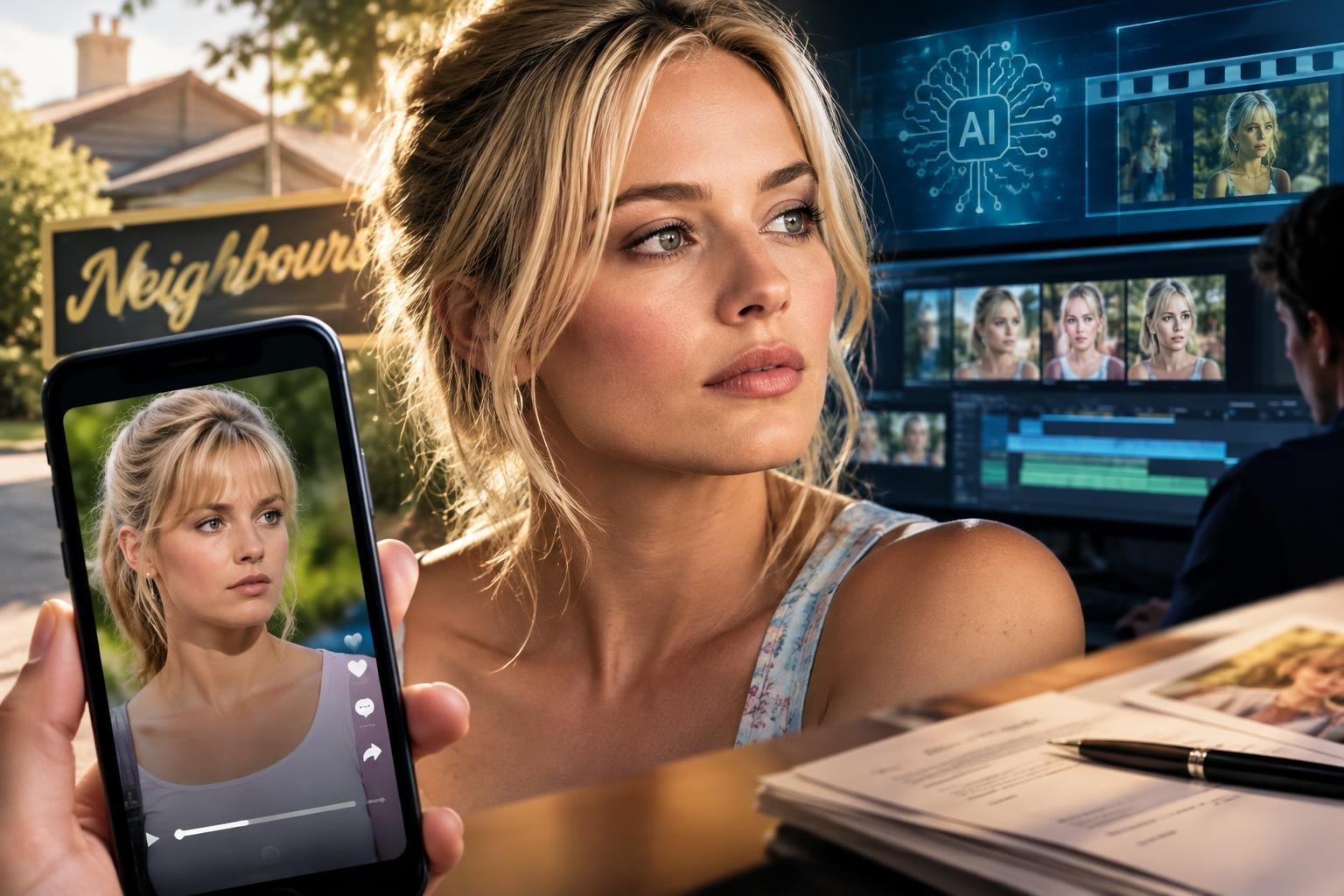
Margot Robbie’s Neighbours character is returning to screens in a new format—but the project is stirring concern among some of the actors whose performances made the original soap. RoseBerry Media is turning existing episodes into short, vertical instalments for phones, using an AI-assisted tool to help reshape the footage.
The first instalments will focus on Donna Freedman, the character Robbie played from 2008 to 2011. Two of Donna’s storylines are being recut into about 150 minutes of microdrama for RoseBerry’s Epis platform. The question hanging over the project is not simply whether an old soap can find a new audience. It is whether performers’ original agreements adequately cover this kind of reuse.
A familiar performance, cut for a new screen
Vertical dramas are designed for phone screens and often tell stories in episodes lasting around a minute. Some are made specifically for the format; others are assembled from existing programmes. In 2023, Paramount Pictures released Mean Girls on TikTok as a sequence of 23 episodes, demonstrating how familiar material can be repackaged for short-form viewing.
Neighbours offers an unusually large archive to work with: it ran from 1985 until 2025 and produced more than 9,300 episodes. Its cast includes performers who later became internationally recognised, among them Robbie, Guy Pearce, Kylie Minogue and Liam Hemsworth. That back catalogue can be seen as both a creative resource and a commercial asset—one whose value depends on performances created years before today’s platforms existed.
Fremantle, which produces the soap, has described the project as a way to find new value in its catalogue. The company says the recut will use only footage, dialogue and performances already broadcast. It also says RedSnapper will not create new scenes or performances, alter actors’ faces or likenesses, or produce synthetic voices. According to Fremantle, the tool assists with catalogue analysis, editing and reframing, with a human editor reviewing the work.
Why some cast members are uneasy
Stefan Dennis, a longtime Neighbours star, called the project invasive and said he was seeking advice through his agent. Matthew Werkmeister, who played Zeke Kinski and appeared in a storyline with Robbie, told Guardian Australia he was concerned about his image being used through AI without his consent. He said he had not been notified by Fremantle or RoseBerry about the deal or whether he would receive residuals.
That concern highlights a distinction at the heart of the debate: the company says it is re-editing existing performances, not generating new ones, while some actors question whether their past contracts anticipate this new form of distribution. Werkmeister said he signed his original contracts as a child and could not recall every term. Guardian Australia reported that residuals would be paid to writers and actors according to their existing agreements, but that does not resolve the broader question of whether those agreements feel adequate to performers.
Werkmeister called the venture a money grab and questioned whether Robbie had been approached; Guardian Australia said it had contacted her for comment. Neither his criticism nor the concerns raised by other cast members establish that the project is unlawful. They do, however, show how quickly new uses of old material can outpace the expectations built into contracts from another era.
A test case for the TV archive
The debate reaches beyond Ramsay Street. The Media, Entertainment and Arts Alliance says it is assisting cast members and representatives, and has called for legislation to ensure creative workers are fairly compensated when their work is exploited using AI. The Australian Writers’ Guild has also said it is in discussions with Fremantle and hopes for a fair resolution.
Meanwhile, the microdrama market—an industry that grew out of China—was estimated to be worth up to US$15 billion globally last year. That figure helps explain the commercial interest in mobile-first storytelling, but it does not answer the questions of consent, credit or compensation. Nor is this project described as generating new performances: Fremantle says it is reshaping material that viewers have already seen.
For audiences, the experiment may offer a brisk route back into a long-running soap. For the people who made it, it is also a reminder that an archive is not just a storehouse of old episodes. As familiar performances are cut into new shapes for new platforms, the industry must decide whether the agreements that kept them on screen are clear enough to govern what comes next.