
Historical films often invite us to admire the scenery. Mike Leigh’s period dramas ask us to notice who is working behind it, who is paying, and what people are arguing about when the spectacle is over. Across four films made between 1999 and 2018, the director turns the past into a crowded, practical place rather than a polished display case.
That approach may seem surprising from a filmmaker best known for contemporary portraits of British life. But Topsy-Turvy, Vera Drake, Mr. Turner and Peterloo share the close observation and interest in relationships that define his modern-set work. Their periods differ; their attention to how people live together does not.
History begins with the work
In Topsy-Turvy, Leigh follows the making of Gilbert and Sullivan’s The Mikado in the 1880s. The film does not treat a celebrated production as a finished cultural monument. It shows a process: ideas meeting money, casting, costume and the everyday demands of the people trying to bring a show to the stage.
That focus makes the film’s creative labour part of its subject. Allan Corduner’s Sullivan and Jim Broadbent’s Gilbert are not simply two famous names attached to a masterpiece; their contrasting temperaments shape the work around them. Meanwhile, the operetta’s cheerful invention sits beside private disappointments and bodily irritations. Art is made by people who still have to live the rest of their lives.
Leigh’s interest in Victorian life began well before the film. His 1993 play It’s a Great Big Shame! connected characters to the same east London address in the late 19th century and the early 1990s. He later described the play as a deliberate Victorian project. The point is not that period detail is incidental: it is that detail matters most when it reveals how a person’s world works.
A social history told through households
Vera Drake shifts the focus to London in 1950. Imelda Staunton plays Vera, a working-class woman whose illegal abortions are discovered by the authorities. The film builds its early picture through family life and the women Vera helps, letting different circumstances emerge without reducing them to a single argument or a tidy social diagram.
After Vera’s arrest, the film’s world contracts. Its earlier breadth gives way to the pressure of a legal system that offers little comfort to its central character. This change in scale is crucial: the audience has seen enough of ordinary life to understand what is at stake when that life is abruptly narrowed. The history here is intimate, but it is not small.
Unlike Leigh’s other period films, Vera Drake does not centre on historical figures. It also draws on some of his own childhood memories, adding another kind of personal connection to the period. Yet the film’s force comes less from nostalgia than from its attention to the different lives gathered around Vera—and to how unevenly the consequences of the law fall.
Many voices, no easy historical hero
Leigh’s later films widen the frame again. Mr. Turner follows the artist J.M.W. Turner during the final 25 years of his life, but resists the familiar biopic shape of a neat, explanatory rise. Timothy Spall’s Turner exists within a network of personal and professional relationships, so the artist is not separated from the people and society around him.
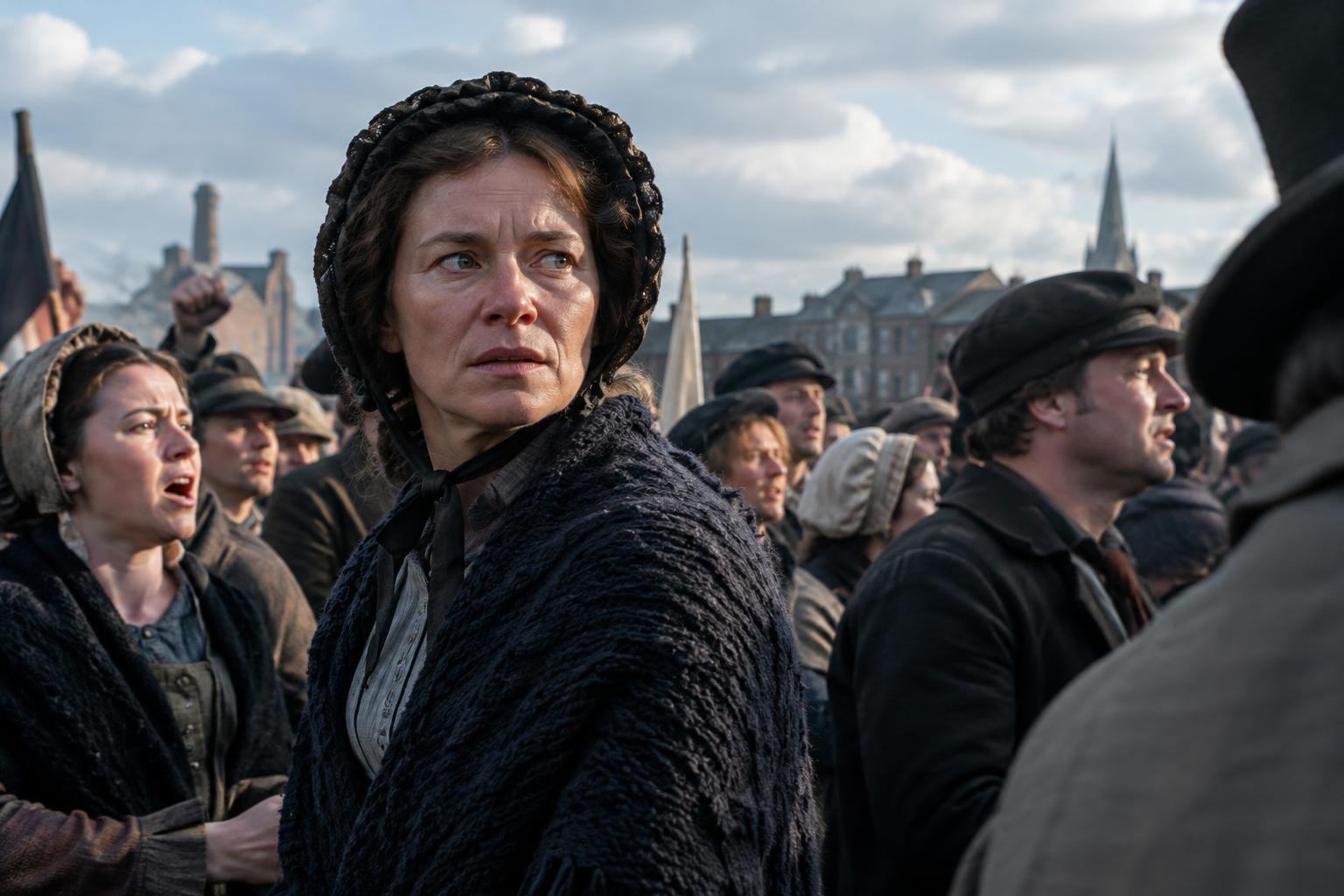
Peterloo looks towards the 1819 attack on peaceful protesters at St Peter’s Field in Manchester. Rather than allowing one character to stand in for the whole event, the film moves among groups and gatherings. Its broad cast gives the subject a democratic form: history arrives through multiple viewpoints, not a single voice with the privilege of hindsight.
That choice also explains why the film’s speeches matter. Debate and rhetoric are not decorative pauses before the action; they are part of a story about political argument and who gets heard. But Leigh also makes room for a detail as modest as Samuel Bamford anticipating a hot potato pie. Such moments do not make history quaint. They remind us that public events take place in lives full of ordinary appetites and concerns.
The past without the velvet rope
Across these films, Leigh avoids two easy comforts: treating the past as an attractive costume parade, and making historical people sound like modern characters in old clothes. Research, language and material detail create distance, while the attention to relationships makes that distance legible.
The result is a useful reminder for anyone choosing a period drama: the most revealing question may not be whether the clothes look convincing. It may be whether the film helps you imagine what people had to make, argue over, endure and enjoy once the grand historical moment was out of sight.