
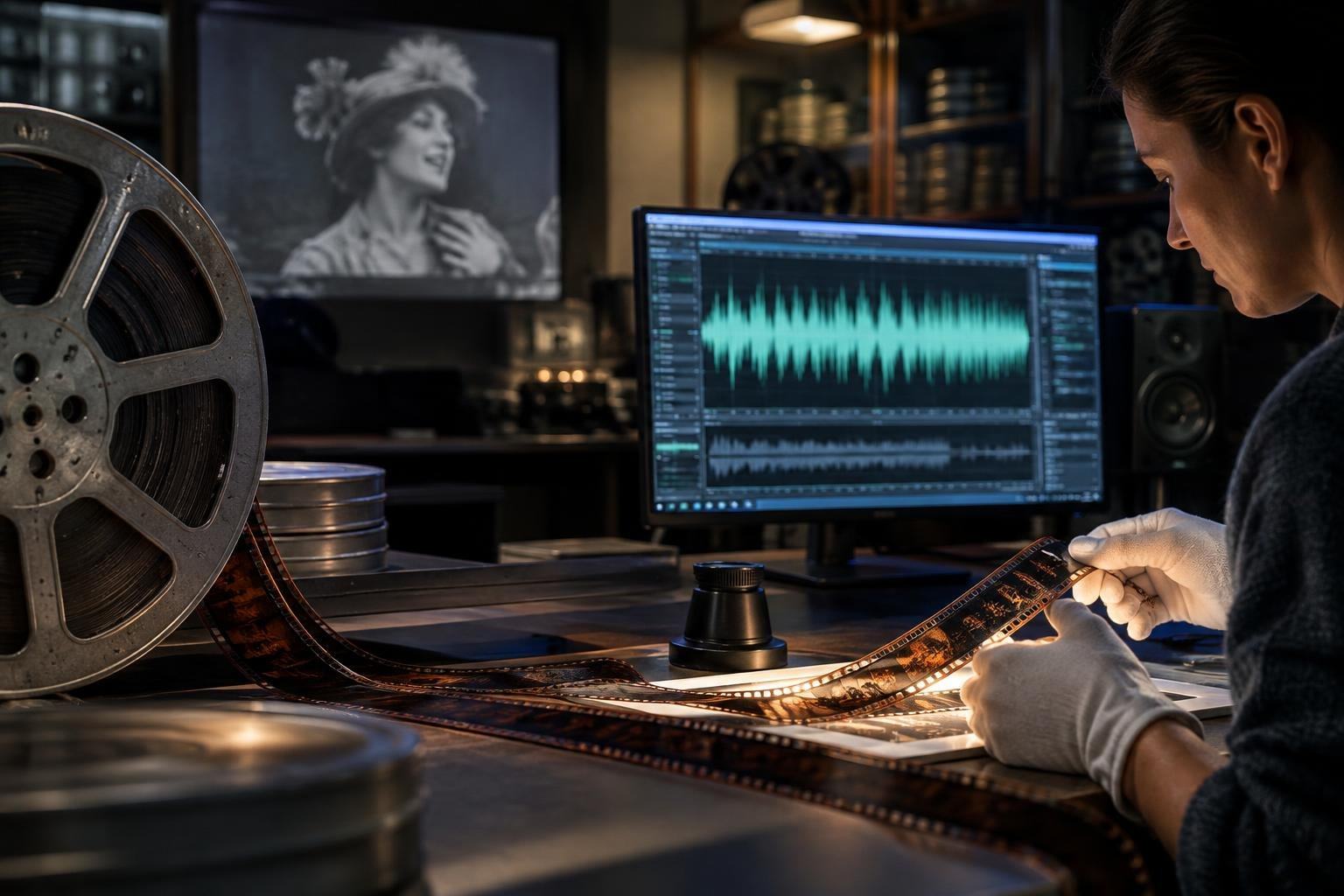
“Sound is 50 percent of the movie going experience,” George Lucas once argued. It is an appealing way to describe something viewers often take for granted: the rustle behind a line of dialogue, the swell of music, or the sudden silence before a door opens. But those sounds do not simply last forever. For film archivists, preserving a movie means caring for what audiences hear as well as what they see.
The BFI National Archive’s account of film sound offers a revealing twist: cinema was not truly silent before talking pictures. Early screenings could feature live musicians, actors or performers making effects. The breakthrough was not the arrival of sound in a cinema, but the ability to record it, control it and keep it in sync with the image.
From wax cylinders to sound on film
One early experiment tried to pair Thomas Edison’s recorded sound with moving pictures. In 1894, Edison and inventor W. K-L. Dickson developed the Kinetophone, an attempt to synchronize wax-cylinder audio with a Kinetoscope. The BFI has also brought together a 1900 film of music-hall performer Lil Hawthorne and an 1898 recording of her singing “Kitty Mahone”—a modern reconstruction that gives a sense of what early audiences could not yet experience reliably.
In the 1920s, Warner Bros.’ Vitaphone system made synchronized sound commercially viable using large shellac discs. Releases including Don Juan (1926) and The Jazz Singer (1927) helped bring recorded sound into cinemas. But the discs were bulky and fragile, and could wear out or break. A more practical answer was to put the soundtrack on the film strip itself.
Early optical soundtracks translated sound into patterns of light recorded beside the picture. In a variable-density track, the brightness of the recorded pattern changed; in a variable-area track, the width of the pattern varied. During projection, light passed through the soundtrack and a photosensitive device converted those changes back into an electrical signal for amplification. Because picture and sound travelled on the same strip, keeping them together became much simpler.
Restoration is careful listening, not noise erasure
That history matters because a film’s sound is not a separate, pristine recording waiting to be uncovered. It may survive on an optical track or another recording medium, each with its own physical condition and technical limits. Over time, damage and wear can affect what can be heard. Restoration begins with the surviving evidence: what is present, what has deteriorated and what the original format can still reveal.
In general, a digital restoration involves transferring the soundtrack into a form that can be examined and worked on with audio tools. The precise approach depends on the material. Specialists may address unwanted noise, clicks or distortions, while adjusting the sound so dialogue, music and effects remain clear. The goal is not to make an old film sound as if it were recorded yesterday; it is to make the surviving soundtrack more listenable without disguising its history.
That distinction is important. A layer of hiss can be distracting, but aggressive noise removal may also take away delicate musical details or the texture of a voice. Likewise, a damaged or missing section cannot simply be restored to its original state by turning up a setting. Any repair involves judgement: improve access to the sound, but do not pretend to recover information that no longer exists.
The soundtrack is part of the film’s history
Sound technology kept developing, from early mono recordings to stereo and multi-channel systems designed to create a wider sense of space. Those changes affect how a film feels, not just how loudly it plays. A voice confined to one channel, or a musical cue moving around a theatre, reflects choices made within a particular era of filmmaking and exhibition.
For viewers, restoration can make that history newly audible. A cleaner line of dialogue or a more distinct musical phrase may change how a scene lands, while the sound’s remaining imperfections can remind us that we are hearing a recording with a past. The aim is not to make the past disappear. It is to let its voices reach us—still recognizably old, but not lost in the noise.