
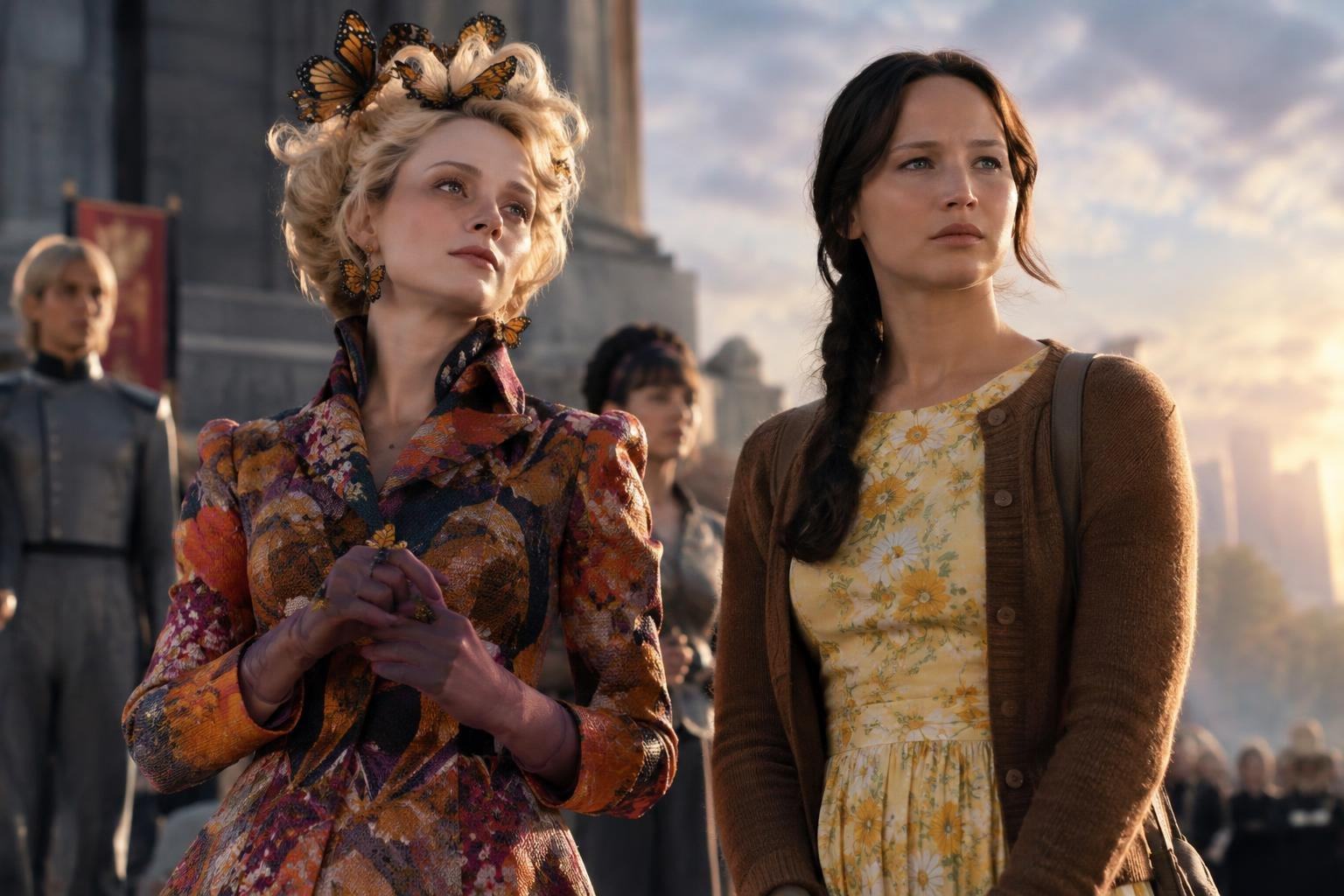
A costume in a prequel has two jobs: it must belong to the story being told, and it must leave room for viewers to recognize the character they already know. In The Hunger Games: Sunrise on the Reaping, that balancing act lands on the clothes of Effie Trinket and Katniss Everdeen—one still finding her style, the other appearing in a brief glimpse of life beyond the earlier films.
Costume designer Bina Daigeler had only a few weeks to prepare before filming began, and this was her first time working in the franchise. The film, which opened in theaters on November 20, is the sixth Hunger Games movie and calls for costumes for 48 tributes—twice as many as the previous films, according to Daigeler’s account in an interview with Marie Claire. The challenge was not simply to make a large wardrobe quickly. It was to create a visual world fans could recognize while giving its younger characters room to change.
Effie’s style is a story in progress
Elle Fanning’s Effie is not yet the elaborate, tightly composed escort audiences remember from Elizabeth Banks’s later portrayal. Daigeler’s approach is to make that difference visible. She describes this Effie as younger, fresher and more free-spirited—someone who has not yet settled into the more formal style associated with the Capitol.
That evolution begins with experimentation. Daigeler developed character and district mood boards, drawing on saturated colors, cinematic shapes and prints associated with the 1960s and ’70s. For Effie, she mixed polka dots, checks and florals, using fabric as a starting point rather than treating clothes as decoration added after the character was established. The mismatched patterns give the look a sense of someone trying ideas on, not yet following a fixed fashion rulebook.
Daigeler also looked to Twiggy and archival Vivienne Westwood designs, while keeping Banks’s Effie in view as a future reference point. The goal was not to copy the older character’s most extravagant outfits. It was to plant visual hints and let Effie’s style gradually become more polished. A high-collared leopard-print suit, worn when she takes on her first reaping as an escort, marks a step toward the more dressed-up figure viewers recognize.
There are smaller echoes, too. Daigeler sourced vintage pieces rather than relying on runway looks, and used butterfly jewelry and headpieces to nod to Effie’s striking monarch-butterfly styling in Catching Fire. The reference works because it is not a full reproduction: it lets the younger Effie’s taste appear in flashes, before that taste becomes a signature.
A familiar Katniss, seen from a different angle
Jennifer Lawrence’s appearance as Katniss brought a different design question. Daigeler revisited the earlier films and focused on the floral, butter-yellow dress Katniss wore in Mockingjay – Part 2. For the new look, she selected a vintage shift dress in a similar shade and print, then gave Lawrence options to consider. As Daigeler explained, the actor knew the character well enough to help decide what felt right.
The choice is a useful reminder that continuity does not have to mean an exact repeat. The familiar color and flowers connect the appearance to Katniss’s established visual identity; the new shape makes it feel like a different moment in her life. A brown cardigan adds warmth, while boots keep the outfit grounded. The design holds together two qualities Daigeler saw in Katniss: empathy and strength.
One detail is easy to miss on screen: the camera shows only the upper part of the outfit, leaving its apron-like shape, fringed skirt and corded belt out of frame. That makes the costume’s work less about spectacle than suggestion. It can help establish a domestic, comfortable side of Katniss without erasing the toughness viewers associate with her.
Clothes that bridge two eras
Daigeler’s compressed schedule and the large ensemble could have made the job a matter of sheer volume. Instead, the most revealing choices are about progression: Effie’s experiments anticipate her later polish, while Katniss’s familiar palette offers a quiet point of recognition. The costumes connect the films not by freezing characters in their best-known looks, but by showing how those looks might have begun—or what they might become.
That is the particular pleasure of costume design in a prequel. A butterfly can be more than an accessory, and an apron can carry more than a practical shape. Both can make a brief appearance feel like part of a longer life, inviting viewers to recognize the person—and notice what has changed.