
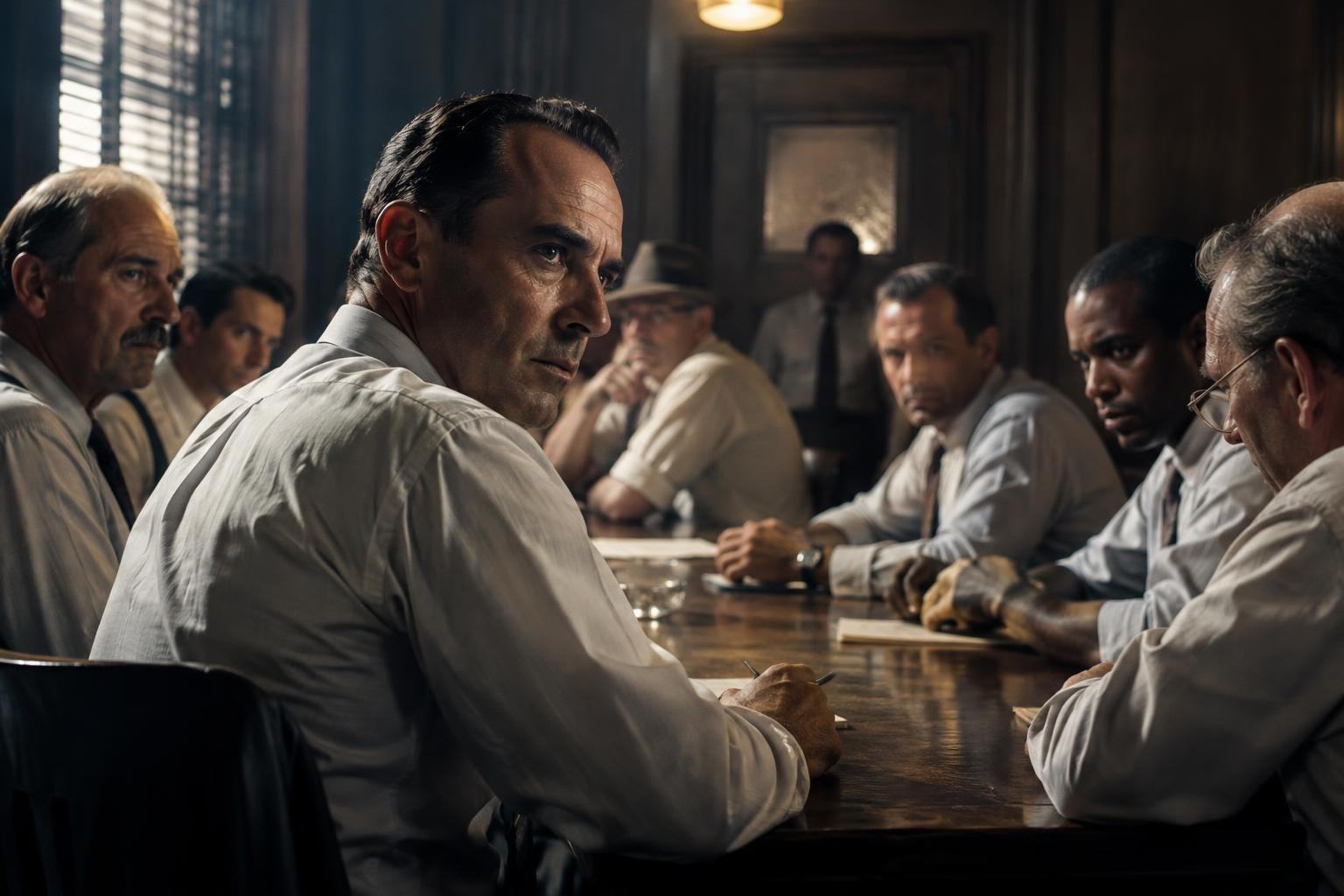
Spoilers ahead for 12 Angry Men.
Twelve jurors sit down to decide whether a young man accused of murder should live or die. Most initially favor a guilty verdict. The room is plain, the action is mostly conversation, and there is almost nowhere for the film to go. Yet Sidney Lumet’s 1957 feature debut turns that apparent limitation into its great strength: as the jurors’ certainty shifts, the room itself seems to change around them.
The film is often cited as an answer to the idea that a dialogue-heavy story in one interior location cannot feel cinematic. Lumet’s answer isn’t to make the room busy. It is to make the camera, the light and the arrangements of bodies do dramatic work that another film might hand to action or a change of scenery.
A room full of individuals, not just a jury
The jurors first appear in the courtroom, watched in a simple tracking shot as the judge explains the responsibility ahead. That movement introduces the group before the film asks us to study them one by one. Henry Fonda, also a producer, is among a company that includes performers familiar from stage and television; the effect is less a parade of stars than a room full of recognizable, distinct people.
After a brief image of the frightened accused boy, the film moves into the deliberation room. An extended opening shot carries us through the space and among the jurors, establishing their positions and relationships without rushing to explain them. The first cut singles out Juror 8, Fonda’s character, whose vote against conviction leaves him isolated from the near-unanimous group.
That initial view is wide and angled down, taking in the table and the raised hands. The framing makes the vote legible as a collective fact. Later, when another juror changes his mind, a closer view gives that small movement greater weight. A raised hand becomes an event because the film has taught us to notice what agreement—and disagreement—looks like.
The camera moves as the argument gathers force
Lumet’s camera does not need constant cutting to keep the conversation alive. In one passage, it follows Juror 8 as he gets up and moves around the room, bringing him into the same frame as the dismissive Juror 7. When Juror 7 moves away, the camera settles on the reactions he leaves behind: amusement on some faces, disapproval on others. One sustained movement turns a remark into a small social test.
The room’s changing light provides another kind of movement. At first, daylight comes through the windows as Juror 8 lays out his doubts. Then rain darkens the scene; later, artificial light takes over. The shift is practical, tied to the passing hours, but it also alters the atmosphere. As the debate grows more heated, Lumet lowers the camera and tightens the compositions. Even when all twelve men remain visible, they seem increasingly crowded together.
The change is especially striking because it is gradual. A higher, wider view can feel observational; a lower, closer one presses the jurors—and the audience—into the conflict. As the camera moves toward eye level and then closer still, faces become harder to read as types or voting blocs. The film makes judgment feel personal before it makes it persuasive.
When the group answers without speaking
One of the film’s most forceful visual passages comes during Juror 10’s racist outburst. The camera begins close to his speech, then pulls back to reveal the other men turning away from him, one after another. Their response does not require a speech of its own. By widening the frame, the film shows how the room’s moral balance has shifted—and leaves the speaker isolated in the silence that follows.
This is the larger craft lesson in 12 Angry Men: a confined setting need not mean a static film. Framing can show who has power, who is being ignored and who has begun to listen. A long take can let discomfort build without cutting away; a close-up can make a change of mind visible; a lower angle can make the same table feel like a trap.
The film’s ending releases that pressure by doing what its earlier scenes could not: it takes us outside. The jurors disperse in the final, widest view, no longer locked around a table or bound by a single decision. The room has not moved. Our sense of it has. That is Lumet’s quiet achievement: he makes the space feel smaller as the argument tightens, then makes the world feel larger when it is finally over.