
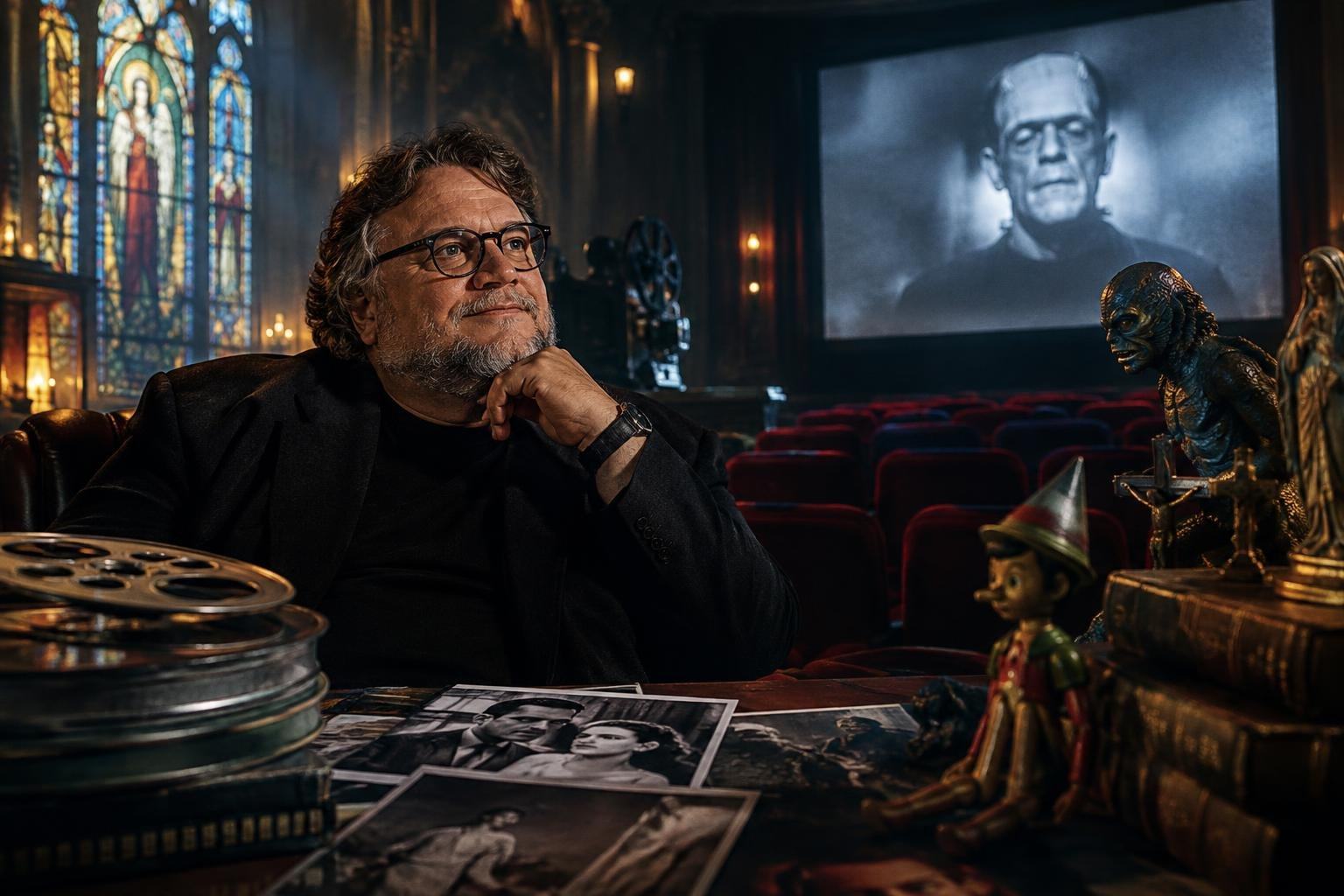
For Guillermo del Toro, going to the movies was never just a way to pass a Sunday. It was a family ritual, a source of wonder and, in his telling, almost a form of worship. That mix helps explain why his films can make a creature’s loneliness feel as spiritually charged as a stained-glass window.
In a new interview for Sight and Sound, published in its June 2026 issue, the Mexican filmmaker traces the roots of that sensibility as he receives a BFI Fellowship. The honour recognises not only a body of work ranging from Cronos and Pan’s Labyrinth to The Shape of Water and Frankenstein, but also his sustained support for film culture and emerging animators.
Where monsters met melodrama
Del Toro’s childhood viewing habits brought two seemingly different traditions into the same frame: Mexican melodramas, especially films directed by Ismael Rodríguez and starring Pedro Infante, and the classic Universal monster movies. He says the combination lodged in his imagination early. In a neat description of his own cinema, he calls it making Rodríguez films with monsters.
That blend is more than a quirky origin story. Del Toro’s monsters are often frightening, but they are also figures of hurt, longing or exclusion. His childhood response to Boris Karloff’s creature in Frankenstein was not simply fear: he saw a kind of martyrdom in the monster’s image. The outsider becomes the emotional centre, while the fantastic gives ordinary human pain a larger shape.
His first trip to a cinema, with his mother, was to see William Wyler’s Wuthering Heights when he was about five. Sundays meant matinees; major openings could become family outings. He remembers going back around the block to queue for Star Wars again, treating repeat viewings like another turn on a ride. These memories offer a useful counterpoint to the idea that a filmmaker’s influences must begin in film school: del Toro’s education started in the seat, through repetition, feeling and attention.
The sacred imagery behind the spectacle
Del Toro describes the theatre as a second cathedral, and his Catholic upbringing gives that comparison a particular charge. His great-aunt, who looked after him while his parents travelled, raised him with a strong sense of sin and Purgatory. He says the religious streak remains visible across his work, from the rosary in Hellboy to the crucifixion imagery he identifies in several films.
For him, the connection is especially clear in Pinocchio, Cronos and Frankenstein: stories about a creator and a created being, and about what children inherit from their fathers. That is not the only way to read those films, but it helps explain why his monsters so often carry moral and spiritual weight. Their bodies may belong to horror or fantasy; their dilemmas are recognisably human.
His formative influences also include Alfred Hitchcock and Luis Buñuel, whom he studied closely, and Federico Fellini. He has spoken of finding Powell and Pressburger later, drawn to their ability to create vivid mental images. Rather than pointing to one master blueprint, these names suggest a filmmaker interested in cinema’s different powers: suspense, surreal disruption, emotional excess and visual invention.
Keeping the next generation in motion
That devotion to film extends beyond his own directing. Del Toro began making Super 8 films at eight and later worked in stop-motion, which he calls one of cinema’s purest forms. He is returning to the technique with The Buried Giant, which the interview says is in production, and he mentored the team behind I Am Frankelda, identified there as Mexico’s first stop-motion feature.
He also helps run a scholarship, with Cinépolis and the Morelia International Film Festival, that sends Mexican animators to study at Gobelins in Paris. A stop-motion studio lab has also been launched there with Netflix. Del Toro frames these efforts as a way to keep creative exchange alive across borders—a practical extension of the openness that made his own influences so varied.
The BFI Fellowship gives a formal name to a career built on looking outward: from Mexican melodrama to Universal horror, from religious imagery to handmade animation. Del Toro’s most revealing lesson may be that cinema’s opposites need not cancel each other out. In the right hands, a monster can be a melodrama’s wounded hero—and a movie theatre can still feel like a place to believe.