
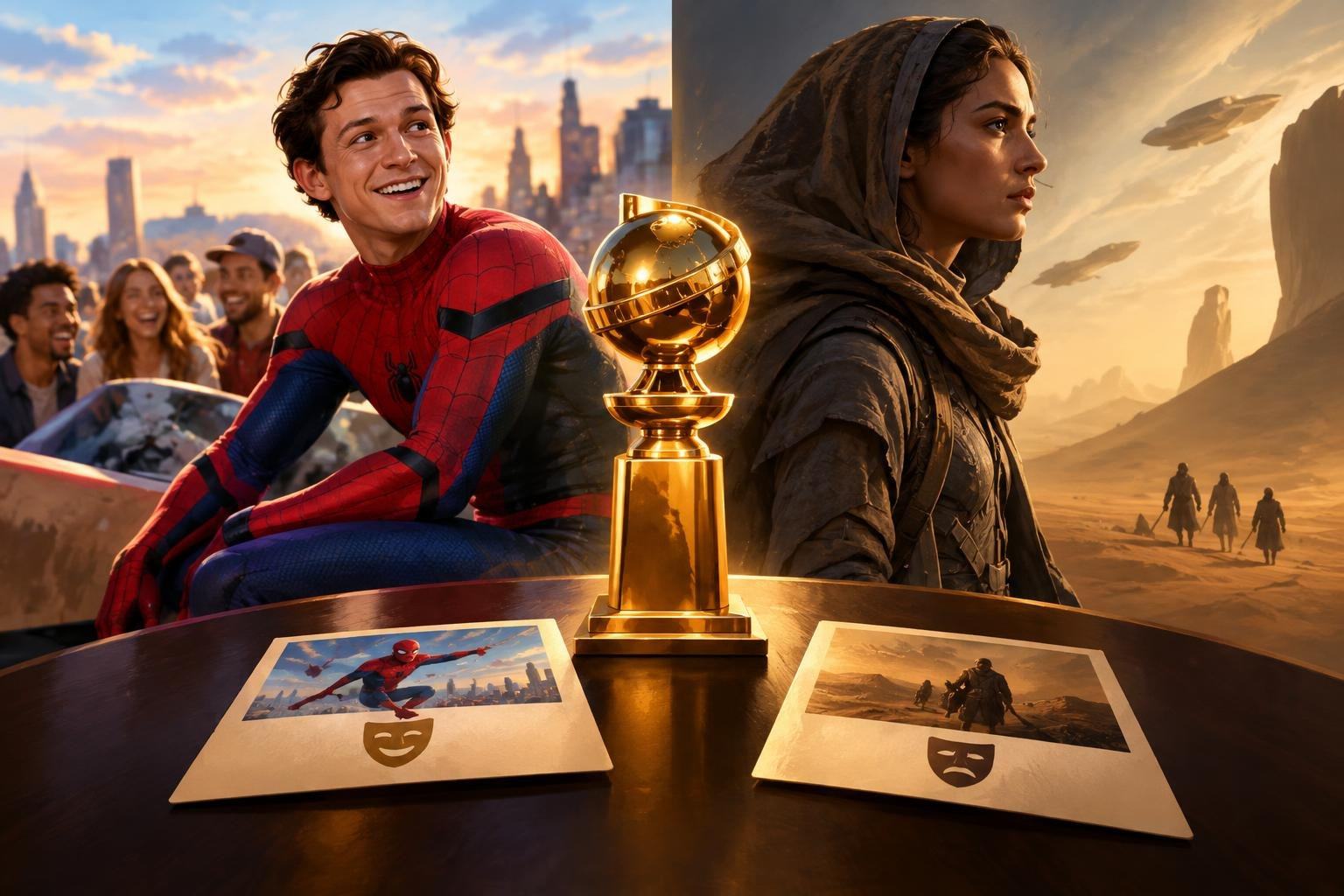
The first Golden Globes drama of the season is not about who gets nominated. It is about where films have been entered. Sony has submitted Spider-Man: Brand New Day as a musical or comedy, while Warner Bros.’ Dune: Part Three is in the drama race but absent from the cinematic and box office achievement category.
Those choices appear on the official motion picture eligibility list for the 84th Golden Globes, obtained by Variety. It covers submissions across seven categories, from acting and directing to original songs and scores. The list is a snapshot of studio strategy—not a list of nominees—and the final selections remain ahead.
Genre labels are part of the campaign
The comedy placement gives Spider-Man a path into a race that Sony is also using for Jumanji: Open World. Tom Holland is submitted for lead actor, with Zendaya, Florence Pugh, Mark Ruffalo and other cast members in supporting categories. For Jumanji, Dwayne Johnson, Jack Black and Kevin Hart are submitted for lead actor, while Karen Gillan is in the lead actress field.
That does not tell audiences how either film will play, or what voters will ultimately think. It does show how category placement can shape the conversation: a comedy submission puts a major franchise in a different awards lane from drama contenders, even when its scale is unmistakably blockbuster-sized.
Netflix is also making a two-track push with The Further Mis-Adventures of Cliff Booth, which appears in both musical or comedy and cinematic and box office achievement. Directed by David Fincher from a Quentin Tarantino script, it has Brad Pitt submitted for lead actor. The film is due for a two-week IMAX-only run before arriving on Netflix on Dec. 23, according to the supplied eligibility report.
Why Dune’s omission stands out
Dune: Part Three has been submitted for best motion picture drama and original score, and its actors—including Timothée Chalamet—are in contention for acting recognition. But it is not among the 20 entries for cinematic and box office achievement, despite being eligible to use projected grosses under the Globes’ rules, the report says.
The category, introduced in 2024, is intended to recognise films with substantial theatrical grosses or comparable streaming viewership documented by trusted industry sources. The new film’s absence echoes Dune: Part Two, which also did not enter the category. That makes the choice notable, but the list does not explain the studio’s reasoning; any claim about its motives would be speculation.
The field includes a broad mix of titles, among them The Devil Wears Prada 2, Godzilla Minus Zero, Michael, Moana, Star Wars: The Mandalorian and Grogu and Toy Story 5. A24 documentary You Can See Everything is also listed. The category’s blend of theatrical and streaming measures makes it an unusual contest: a film’s route to recognition may matter as much as its box-office story.
Animation and crowded acting races
Animation is crossing category boundaries, too. Eight of the 24 animated submissions also appear in a best picture field. Brad Bird’s Ray Gunn, for instance, is listed in drama, while Forgotten Island, Minions & Monsters and The Super Mario Galaxy Movie join the comedy side. Pixar’s Toy Story 5, by contrast, is entered for animation and box office achievement, but not musical or comedy.
The submissions also put some performers in competition with themselves. Zendaya appears across four films, with entries in both lead actress fields and in supporting actress. Robert Pattinson also has four titles spread across lead and supporting races. Such overlaps are a reminder that these ballots assess individual performances as well as films—and that a busy year can produce a crowded personal field before nominations are even announced.
There is a wider representation question in the directing submissions: 23 of 131 directors on the reminder list are women, or about 18%, according to the report. It is an eligibility-stage tally, not a prediction of the final directing nominees, but it offers an early measure of who is in the conversation.
Ballots are due Dec. 4, nominations are scheduled for Dec. 7, and Nikki Glaser is set to host the ceremony on Jan. 10. Until then, the most revealing part of the Globes race may be the choices made before voters cast theirs: what a studio submits can say as much about its awards strategy as the category itself says about the film.