
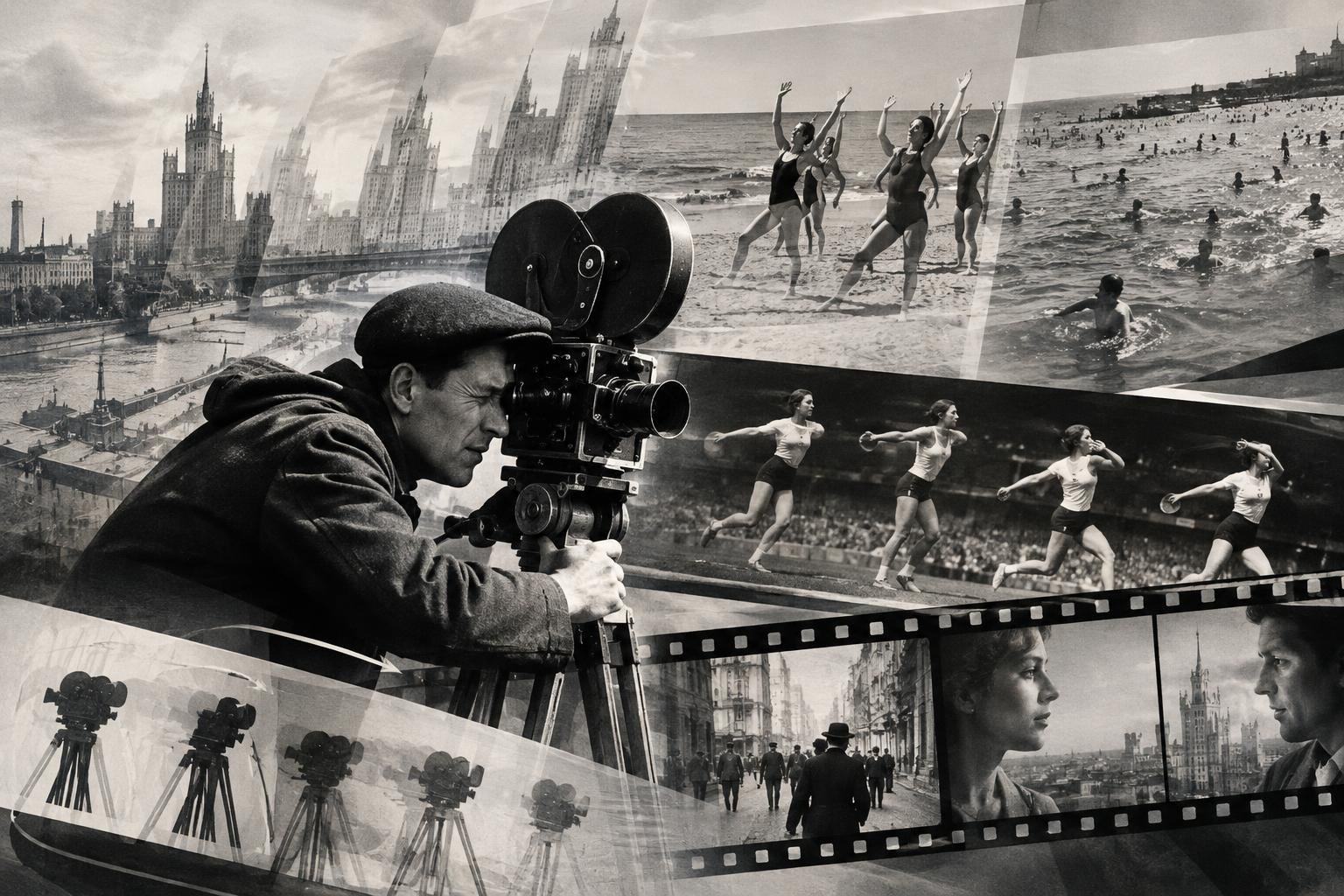
A film can make a city fold in on itself without a digital effects team. In Dziga Vertov’s Man with a Movie Camera, released in 1929, images overlap, speeds shift and a camera appears to move by itself. The results are playful, but they also reveal something fundamental: cinematic effects can shape how we experience an image, not merely make the impossible look real.
That is one reason the silent documentary remains so lively to watch. Vertov’s experiments weren’t all inventions, and the visual techniques he used have histories of their own. But his film brings them together with an energy that makes it a useful guide to the possibilities of cinema—and to effects that still turn up in films from Doctor Zhivago to Inception.
When time becomes part of the image
A dissolve lets one image fade into another, briefly placing both on screen. In Vertov’s film, it can make a quiet location seem to fill with life: an empty beach gives way to women exercising, while a still stretch of water becomes busy with swimmers. The transition doesn’t just connect two shots; it makes change itself visible.
That simple ability has kept the dissolve useful for showing time passing or linking moments. David Lean’s Doctor Zhivago (1965), for instance, uses transitions to evoke the changing seasons. In other films, a dissolve can suggest that two events belong close together, even when the edit moves between separate images.
Vertov also alters the speed of filmed action. By changing how many frames the camera captures, then running the footage at the projector’s usual speed, he could make movement appear slower or faster. During an athletics sequence, a woman’s turn and discus throw unfold in slow motion. What might otherwise be a fleeting sports moment becomes a display of balance and force. Modern audiences may associate manipulated time with The Matrix’s bullet-time effects, but Vertov’s sequence shows how slowing an image can change what we notice.
When objects refuse to behave
One of the film’s most mischievous tricks gives its title character a little competition: the camera seems to spring to life, turning and moving on its own three legs. The illusion comes from stop-motion, made by shifting an object slightly between exposures. A succession of still positions then appears to move when the film plays.
The technique would become familiar in everything from Ray Harryhausen’s fantastical creatures to the handmade animation of Wallace and Gromit. Vertov had already directed Soviet Toys, an animated film, before bringing a related frame-by-frame sensibility into this live-action work. The camera’s apparent independence also suits a film fascinated by the act of filming: the equipment becomes a performer, not just a tool.
One screen, more than one point of view
Vertov repeatedly divides or combines images to make the frame do more than one job. A split screen can show different actions or spaces at once, inviting viewers to compare them rather than follow a single uninterrupted view. In the era of hand-cranked cameras and physical film, creating such compositions could involve masking part of the frame and exposing the strip again.
The technique remains a recognisable stylistic choice, from Brian De Palma’s films to 500 Days of Summer and 127 Hours. Its appeal is more than visual novelty: a divided image can make parallel experiences feel simultaneous, or show how two perspectives differ without explaining the contrast in dialogue.
Double exposure offers a different kind of collision, laying one image over another on the same strip of film. Vertov uses it to create images that defy ordinary space—including a memorable shot that places the cameraman inside a glass of beer. Later, filmmakers often used the technique to conjure ghosts. Christopher Nolan’s Inception takes a digital route to its own reality-bending images, including a city folding over itself, while also paying homage to Vertov’s visual imagination.
The effect is more than the trick
These five techniques aren’t simply a checklist of early special effects. They show how editing, timing and composition can make viewers feel that time has shifted, space has split or an object has come alive. That expressive power is why their descendants still work, whether made with strips of film or computer graphics.
More than 85 years after its release, Man with a Movie Camera still offers a refreshing question for anyone watching a visual spectacle: what does this effect help us see that an ordinary shot could not?