
Today, a film from another country can sit a few taps away from the latest Hollywood release. In the 1950s, British audiences often needed someone to find that film, bring it into the country and persuade a cinema to show it. Contemporary Films made that work its mission—and helped turn international cinema into a lasting part of British film culture.
The distributor behind the discovery
Founded in 1951 by Charles Cooper, Contemporary began in a difficult climate. British rules supported domestic films, while movies from beyond the Anglo-American industries had no equivalent safety net. Cold War politics added another obstacle: many of the company’s early choices came from countries on the other side of the Iron Curtain.
At first, the company worked largely outside mainstream cinemas, supplying films to societies and other venues using 16mm projectors. That modest route mattered. Britain’s postwar film-society movement gave curious viewers somewhere to encounter movies that commercial distributors were less likely to take a chance on.
But choosing a title was only the beginning. Unlike a major studio releasing its own productions, an independent distributor had to identify films, find cinemas willing to book them and build an audience for unfamiliar filmmakers. Contemporary was not simply importing films; it was helping create the conditions in which British viewers could see them.
Why 1958 changed the picture
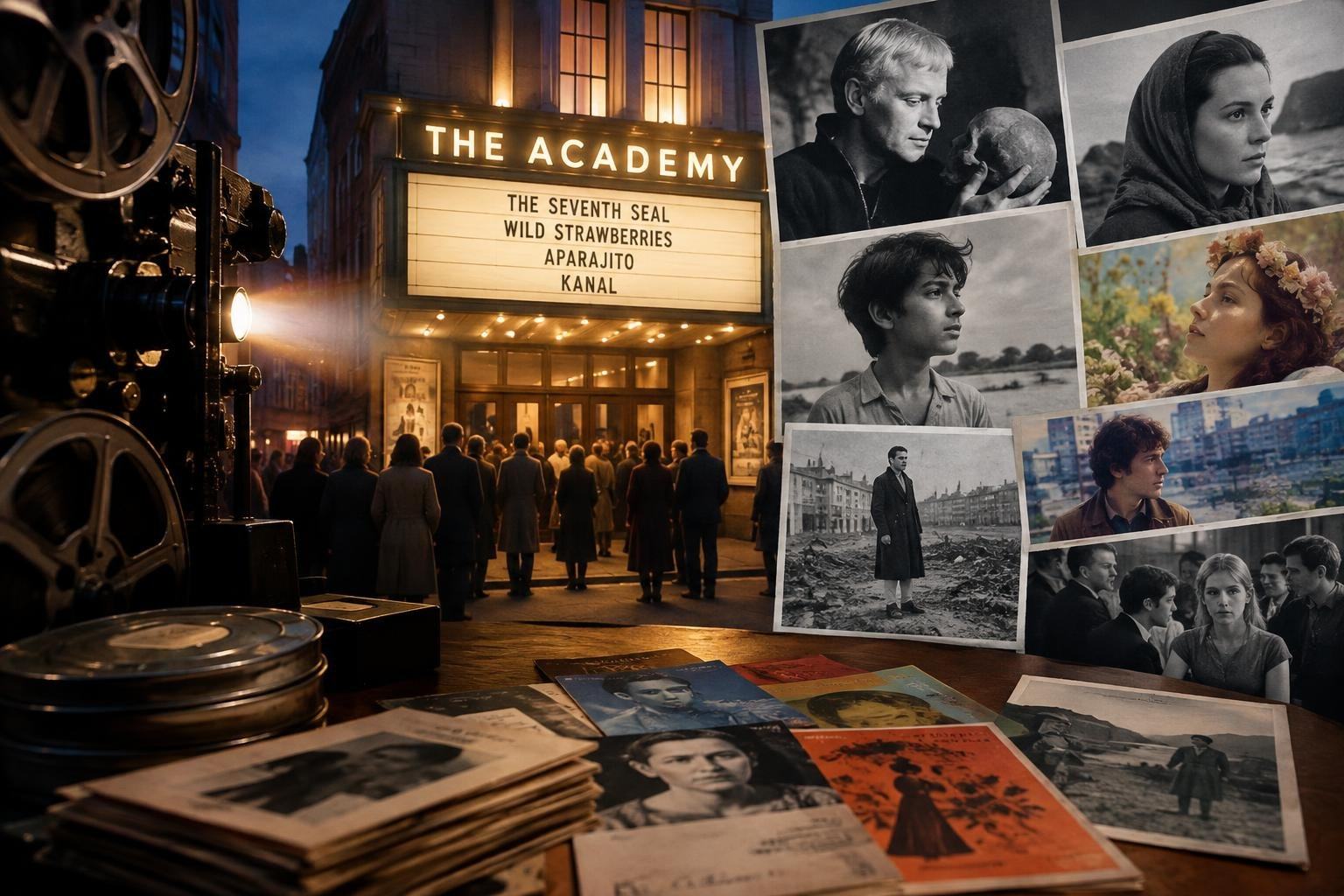
A remarkable run of releases in 1958 shows how that effort gathered force. Contemporary brought out Satyajit Ray’s Aparajito, Ingmar Bergman’s The Seventh Seal and Wild Strawberries, and Andrzej Wajda’s Kanal. All opened at London’s Academy Cinema, a key home for art films.
Some had already reached festival audiences: the first three titles were shown at the 1957 London Film Festival. But a festival screening and a theatrical release do different jobs. The Academy bookings gave these films a chance to travel beyond a one-off event, while Bergman’s work in particular helped draw audiences beyond committed film-society regulars and London’s cinephile circles.
That distinction helps explain the distributor’s influence. A filmmaker may become internationally celebrated, but audiences in a particular country still need opportunities to see the work. Contemporary helped make directors including Ray and Bergman familiar names in Britain—and continued its relationship with Ray into later decades.
From Prague to suburban London
The company’s range stretched well beyond its celebrated 1958 releases. In the 1960s it introduced British viewers to filmmakers including Miklós Jancsó, Jerzy Skolimowski, Sergei Parajanov and Czech directors Miloš Forman, Jan Němec, Ivan Passer and Věra Chytilová. It also took part in bringing early films by French New Wave directors Claude Chabrol and Jacques Rivette to British screens.
In 1968, Contemporary released Chytilová’s Daisies at the Paris Pullman, a cinema it had taken over the previous year. The film’s arrival came shortly before the Soviet invasion that ended the Prague Spring. Contemporary’s programme also reached toward the late-1960s youth audience with late-night screenings and politically charged work such as Tomás Gutiérrez Alea’s Memories of Underdevelopment.
Yet its interests were not limited to international auteurs. In 1972, the company released Mike Leigh’s first feature, Bleak Moments, a study of isolation in a London suburb. Leigh later recalled that, before moving to London as a student, he had not seen a film that was not in English. Discovering world cinema, he said, was an “explosive revelation.”
A legacy with a cinema address
Contemporary was a family business, run by Cooper with his wife Cecilia, her brother Harry and his wife Rose. Cecilia died in 1958, during the company’s pivotal year; Cooper considered shutting down, but the family continued. His second wife, Kitty, later joined him in choosing films. The Paris Pullman closed in 1983 and the Academy in 1986, marking the end of the boom in dedicated commercial art cinemas described in the anniversary account.
The distributor, however, survives, including through the continued circulation of classics such as Jean Renoir’s La Règle du jeu. A 75th-anniversary season, Contemporary at 75, begins at BFI Southbank on 3 September with Bleak Moments and a conversation with Leigh.
That opening choice brings the story full circle: a company that helped British audiences look beyond familiar film industries also backed a distinctive British filmmaker. Its achievement was not just bringing unfamiliar movies across borders. It was making discovery feel like part of going to the pictures.