
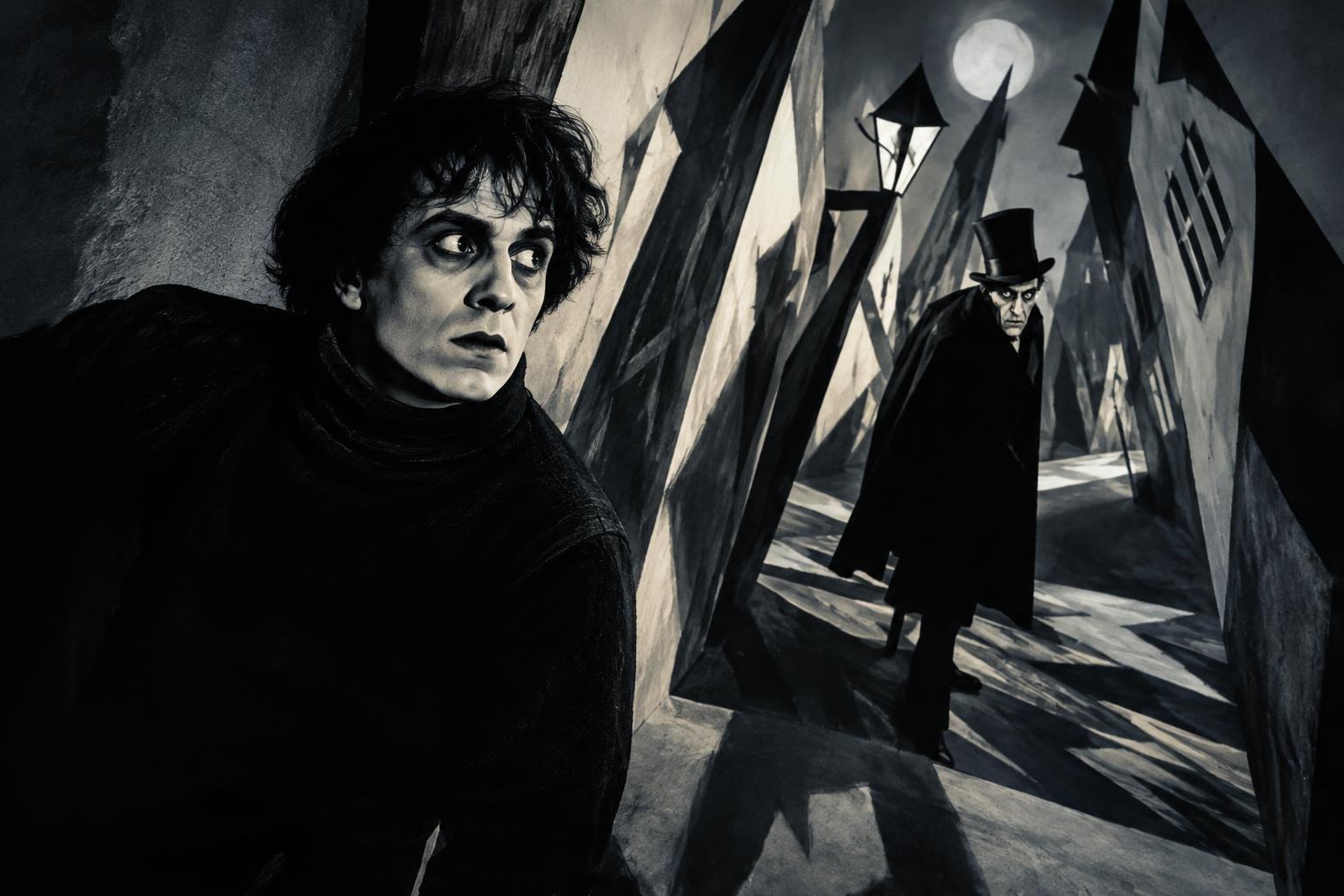
On 26 February 1920, a film arrived in Berlin that seemed to bend the world around its characters. In The Cabinet of Dr. Caligari, streets tilt, shadows slice across walls and painted shapes stand in for ordinary architecture. A century later, those images remain striking. But the film’s deeper unease comes from the possibility that the authority promising to restore order may be part of the nightmare.
Directed by Robert Wiene, the silent horror follows Franzis, a student whose friend is murdered by Cesare, a somnambulist controlled by the hypnotist Caligari. That premise gives the film the machinery of a fairground shocker. Its real subject, though, is harder to settle: how much can we trust the story we are being told?
A nightmare built from a nation’s unease
Caligari emerged from a Germany still grappling with the devastation of the First World War. Defeat, economic hardship and the human cost of the conflict shaped the atmosphere of the postwar years. The film’s world, with its cramped spaces and distorted perspectives, gives that unease a visual form rather than offering a realistic account of everyday life.
Its violence could also carry a particular weight for audiences living with the memory of mass death. Later interpretations have read Cesare as an image of young men sent to fight and die at the command of those in power. That is a critical reading, not a plot fact—but it shows how readily the film’s small-town terror can open onto larger fears about obedience and control.
The timing mattered beyond Germany, too. As restrictions on German films in international markets began to ease after the war, Caligari travelled as an unmistakably German production. Earlier films had sometimes been stripped of their German identity for overseas screenings. This one helped put German cinema back into view, carrying its distinctive style with it.
When the set becomes part of the story
Expressionism was already flourishing across the arts, from painting and theatre to literature and architecture. Rather than reproduce the external world faithfully, it reshaped it to express an inner state. Caligari brought that idea into nearly every corner of its design: sharp angles, skewed buildings and painted shadows make the setting feel less like a town than a mind under pressure.
The approach was artistically daring, but it also offered a practical advantage. The production’s leaders expected the unusual look to attract attention, even if critics were unsure what to make of it. Style was not decoration laid over the story; it was the story’s atmosphere made visible. The performers’ stark gestures and angular movements seem to belong to the same geometry as the sets, so that people and place feel caught in one design.
That unity is part of why the film became such a durable reference point for horror. A threatening space need not be a realistic one. A crooked doorway or an impossible shadow can make a viewer distrust the room before anything frightening happens. Caligari’s influence lies not only in its images, but in the permission it gave filmmakers to make the world itself feel dangerous.
The twist that refuses to settle anything
The film’s frame story complicates that visual world. Franzis recounts the tale, then the ending reveals him to be a patient in an asylum—and Caligari to be its director. The twist appears to reclassify the horrors as delusions. Yet the supposedly ordinary asylum shares the same stylised look as the story Franzis has told, making it difficult to draw a clean line between the imagined and the real.
The critic Siegfried Kracauer argued that the framing device weakens the film’s anti-authoritarian force: Caligari’s crimes become the fantasies of a madman, while the doctor regains institutional authority. But the final scene leaves a troubling wrinkle. Caligari believes he can cure Franzis. Whether that assurance signals benevolence or a new form of control is left open to interpretation.
That uncertainty is the film’s most modern shadow. Its crooked streets may belong to a century-old visual style, but its central discomfort remains familiar: when an institution claims to distinguish truth from delusion, who gets to make the call? Caligari never makes the answer easy—and that is why the cabinet still feels open.