
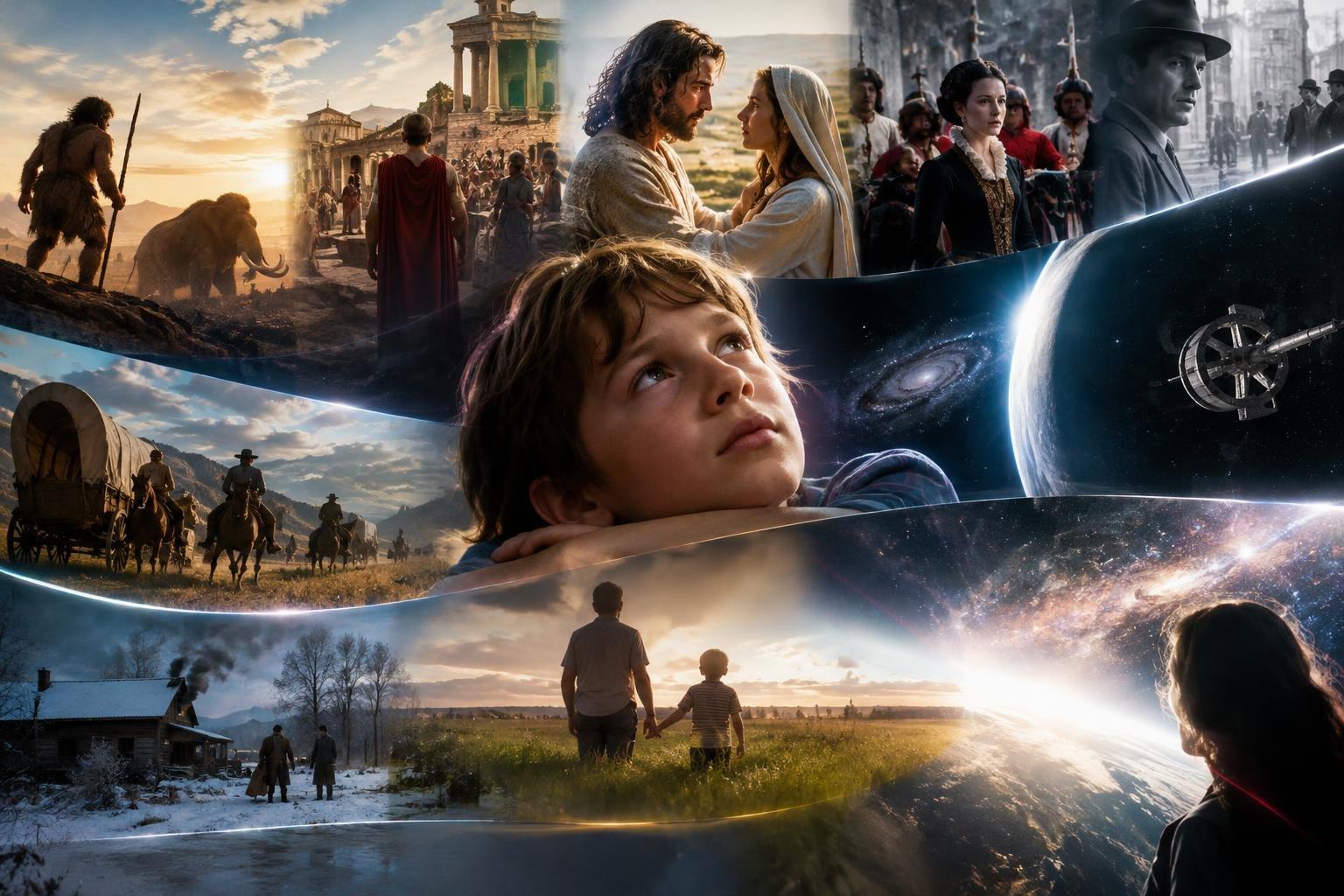
Most films make time feel manageable: a few days, a year, perhaps a lifetime. But some take on far more, folding decades, centuries or even the history of the universe into a single feature. Their trick is not simply to show a lot of events. It is to find a form that makes enormous change feel personal.
Robert Zemeckis’s Here (2024) offers an especially striking example. Inspired by Richard McGuire’s graphic novel, it keeps its camera fixed on one patch of land while the view shifts between its distant past and the generations who eventually make a home there. It is a reminder that a seemingly ordinary room can sit atop an almost unfathomable history. These nine other films find their own ways to make time visible.
When history becomes the spectacle
Intolerance (1916) brings four stories from different eras into conversation: ancient Babylon, the life of Christ, the St Bartholomew’s Day massacre and a contemporary tale of wrongful conviction. D.W. Griffith’s monumental production was made in the shadow of the racist controversy around The Birth of a Nation. Its ambition to condemn intolerance is not an answer to that film’s harm, but its interwoven timelines remain a landmark in cinematic cross-cutting. In the climactic passages, cutting between centuries makes distant injustices feel like parts of one continuing pattern.
How the West Was Won (1962) follows one family through five chapters and 50 years of 19th-century American history. Its original Cinerama presentation used three synchronised cameras and a curved screen, making the landscape part of the draw. The changing fortunes of a family give the film a human thread through frontier settlement, war and migration—though its vision of westward expansion is also a product of the era in which it was made.
In Siberiade (1979), director Andrei Konchalovsky makes a remote Siberian village the vantage point for more than 60 years of upheaval. Political change and industrial ambition reach even this isolated community, where the push to find oil collides with local traditions and the natural world. The village is small; the forces shaping it are not.
From creation myths to ordinary growing up
History of the World: Part I (1981) turns the sweep of human history into a series of comic sketches. Mel Brooks visits the Stone Age, ancient Rome, the Spanish Inquisition and the French Revolution, treating grand historical subjects with irreverent jokes rather than solemnity. Its fragmented structure makes a useful point: a film can cover vast ground without pretending that history is one smooth, orderly march.
Stanley Kubrick’s 2001: A Space Odyssey (1968) makes an even more radical leap, moving from prehistoric humanity to the space age and beyond. Its famous shift from a bone thrown into the air to an orbiting spacecraft compresses an immense stretch of technological change into one cut. The film lets images, music and silence do work that dialogue might usually handle.
Terrence Malick’s The Tree of Life (2011) places a family’s memories of 1950s Texas beside sequences evoking the origins of the cosmos and life on Earth. Rather than treat the universe’s history as background information, the film sets the intimate scale of childhood against the nearly incomprehensible scale of creation. The contrast is the point: a private grief can feel both small and immeasurable.
Richard Linklater’s Boyhood (2014) takes the opposite route. Filmed over 12 years with the same young actor, it follows a boy growing up, letting real changes in the performers’ faces and bodies register the passage of time. There are no grand historical leaps to announce each new stage. A haircut, a new school year or a family’s changing circumstances can do the job.
Lives, legacies and time out of order
The Last Emperor (1987) traces the life of Pu Yi, from his childhood as China’s emperor to the later stages of his life under a radically changed political order. Its broad historical canvas is grounded in one person’s shifting identity: the boy once surrounded by imperial ceremony must reckon with a world in which that position no longer exists.
Cloud Atlas (2012) connects six stories across different periods, from the 19th century into the future. Its interlocking structure asks viewers to notice echoes between lives separated by time, rather than follow a single chronological line. Together, these films show that cinematic time need not be a straight road. It can be a family’s inheritance, a civilisation’s upheaval or a room that has quietly outlasted everyone who once called it home.